
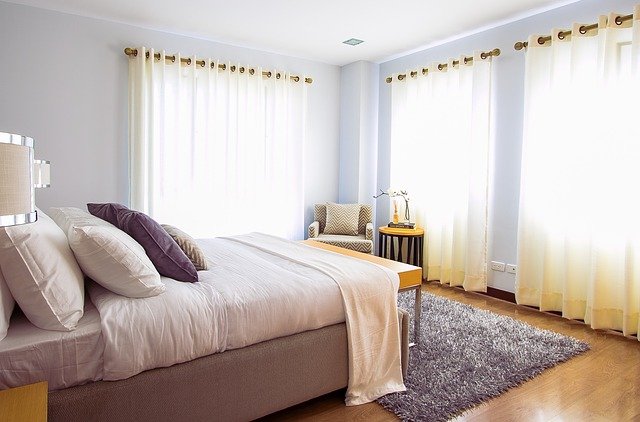
Updated October 2026. How to pick wall-to-wall carpet or a rug for a bedroom: pile styles, padding, fibers, indoor air labels and sizing, plus whether new carpet is worth it before you sell. Sources were read on October 28, 2026.
For most bedrooms, a soft cut-pile carpet such as plush or Saxony works best, laid over a 7/16-inch pad with 6 pounds per cubic foot of density, the spec the Carpet and Rug Institute gives for cut pile (as cited by HowStuffWorks, read October 2026). Bedrooms get light traffic, so you can favor comfort over toughness. Pick a low-VOC labeled product and air the room out after install.
Jump to: 🏠 Pile styles · 📸 Padding · 💲 Fiber and budget · 🤝 Rugs · 🪜 Before selling · ❓ FAQ
Key takeaways
- Cut pile or cut-loop carpet: 7/16-inch pad, 6 lb density. Berber or thin loop: 3/8-inch pad or thinner, 8 lb density.
- Plush and Saxony feel softest but show footprints. Berber and textured styles hide tracks better.
- The EPA says levels of several organic chemicals average 2 to 5 times higher indoors than outdoors, so low-emission labels matter in a room you sleep in.
- In NAR’s 2025 remodeling report, 27% of homeowners said they remodeled to replace worn-out surfaces and finishes.
A bedroom is the one room where you walk barefoot every day. That makes it the easiest place to justify soft carpet. It’s also where a bad pad or the wrong fiber shows up fastest, as dents by the bed and matted paths to the closet. Here’s how we’d choose, step by step.
Which carpet pile is best for a bedroom?
Pile is the surface you see and feel, made of yarn loops, cut tufts or both. The style changes how soft it feels and how much it shows wear. HowStuffWorks’ guide to choosing carpet breaks it down well. Here’s the short version.
| Pile style | Feel | Shows footprints? | Best for |
|---|---|---|---|
| Plush | Thick, soft, tightly twisted | Yes, plus vacuum tracks | Primary bedroom, low traffic |
| Saxony | Soft, similar to plush; the most common type | Yes | Bedrooms, formal rooms |
| Frieze | Soft, slightly fuzzy, casual | Hides them well | Kids’ rooms, guest rooms |
| Textured | Fibers cut to mixed heights | Hides them | Busy bedrooms, pets |
| Berber (loop) | Flat, dense, firm | Hides them | Hallways, stairs, playrooms |
Soft underfoot is the goal in a bedroom, but not too soft. If your feet sink deep and the pile flops over, it will mat fast. Plush and Saxony are the classic picks for a primary bedroom. For a kid’s room or a bedroom that doubles as an office, a frieze or textured cut pile holds up better and still feels warm.
Plush has one quirk worth knowing. It can “pool,” meaning patches look shaded because the fibers lean the other way. It’s a look, not a defect, but some people hate it. Walk on a big sample in socks before you decide.
What carpet padding should you use in a bedroom?
Don’t save money on the pad. It supports the carpet, hides small bumps in the subfloor, adds some insulation and soaks up sound. A weak pad is why new carpet wears out early. HowStuffWorks, citing the Carpet and Rug Institute, gives two specs worth writing down:
- Cut pile or cut-loop carpet: 7/16 inch thick, 6 pounds per cubic foot.
- Berber or thin loop carpet: 3/8 inch or thinner, 8 pounds per cubic foot.
Thicker isn’t always better. A pad that’s too thick under a loop carpet lets it flex and pull apart. Ask the store which pad the carpet maker requires for the warranty. Get it in writing on the quote, along with separate prices for the carpet, the pad and the install. That way you can compare stores line by line.
Which carpet fiber fits your budget?
Wool is the top of the range in feel and price. Nylon and other synthetics feel close to wool and cost less, which is why they fill most showrooms. Polyester and olefin are budget picks; they’re fine for a guest room you rarely use. If you have pets or small kids, look at stain-resistant lines or carpet tiles, so you can swap one square instead of the whole room.
Bedrooms are where you breathe for eight hours a night, so think about emissions. The EPA notes that levels of several organic pollutants average 2 to 5 times higher indoors than outdoors, and new building materials are one source. The Carpet and Rug Institute’s Green Label Plus program, launched in the 2000s, tests carpet, cushion and adhesives for very low VOC emissions. Look for that label, and open the windows for a few days after install.
Color comes last, but it matters. Match the carpet to the wall color and bedding you’ll keep for years, not this season’s throw pillows. Mid-tones like greige and soft taupe hide lint and pet hair better than white or dark navy. Take samples home and look at them in morning and evening light. Our guide to flooring options: carpet, wood, bamboo or tile helps if you’re still deciding between materials.
Should you use carpet or an area rug in the bedroom?
If the room already has hardwood or tile you like, a rug gives you the soft landing without covering the floor. Size it to the bed. In a queen room, a rug large enough to reach about two feet past each side of the bed means your feet land on it every morning. Smaller runners on each side work in tight rooms.
Style is personal. Hand-knotted wool pieces like turkish rugs bring color and pattern to a plain room and last for decades. If you have pets or kids, look for rugs that are washable and stain resistant; Good Housekeeping tests and ranks them. Put a non-slip pad under any rug on a hard floor.
Sell smarter
List your home on the MLS from $99
A flat fee instead of a percentage, and $0 to Beycome at closing. You stay in control of your sale.
Sell your home →Buy smarter
Get up to 2% back at closing
On homes listed by other agents, Beycome credits you up to 2% of the price at closing (1% kept, $1,499 minimum; not on FSBO homes or homes listed by Beycome sellers).
Buy a home →For layout ideas, see How to Choose the Perfect Living Room Rug to Elevate Your Space and Enhance Your Living Space with the Perfect Area Rug. The same sizing rules carry over to the bedroom. To finish the look, Ways You Can Decorate With Pillows pairs well with a new rug.
Should you replace bedroom carpet before selling your house?
Only if it’s stained, smells or looks clearly worn. Buyers notice carpet in photos and walk-throughs, and they tend to price in replacement. In NAR and NARI’s 2025 Remodeling Impact Report, 27% of homeowners said their main reason to remodel was upgrading worn-out surfaces, finishes and materials. The same report found REALTORS most often suggest painting the whole home (50%) before listing.
So start cheaper. A deep professional clean can save carpet that’s only dirty. If you do replace, pick a neutral mid-grade nylon in one color across all bedrooms. It photographs well and doesn’t fight anyone’s furniture. If the carpet hides hardwood, pull up a corner in a closet. Many buyers would rather see wood, and our guide to floor polishing for every surface shows how to bring it back.
For the bigger picture on the room itself, read How to Upgrade the Bedroom to Make it a Selling Point of Your Property. And plan your listing photos after the carpet goes in, not before; our real estate photo tips cover lighting and angles.
When it’s time to list, Beycome puts your home on the MLS for a flat fee in 17 states and DC. Basic is $99 and Enhanced is $399, with $0 at closing. With Concierge, experts give you full support through pricing, showings and offers, and you stay in control. It’s $1,399. Basic is $129 in California and Illinois.
Bedroom carpet questions
What type of carpet is best for a bedroom?
A soft cut pile like plush or Saxony for a primary bedroom. Frieze or textured cut pile holds up better in kids’ rooms and busy guest rooms.
How thick should carpet padding be in a bedroom?
For cut pile, the Carpet and Rug Institute spec cited by HowStuffWorks is 7/16 inch at 6 pounds per cubic foot. For Berber or thin loop, 3/8 inch or thinner at 8 pounds.
Is plush or Berber better for bedrooms?
Plush feels softer but shows footprints. Berber is tougher and hides wear, so it suits stairs and hallways more than bedrooms.
Is new carpet safe to sleep on right away?
Choose a low-emission product such as CRI Green Label Plus, and ventilate the room for a few days. The EPA says indoor levels of some organic chemicals run 2 to 5 times higher than outdoors.
What size rug goes under a queen bed?
Pick one that reaches about two feet past each side of the bed, so your feet land on it when you get up.
Should I replace carpet before selling my house?
Only if it’s stained, smelly or badly worn. Try a deep clean first; if you replace, use one neutral mid-grade carpet in every bedroom.
Pile styles and padding specs per HowStuffWorks, 10 Tips for Choosing Carpet (updated April 16, 2024), which cites the Carpet and Rug Institute. Green Label Plus per CRI. Indoor VOC levels per the EPA. Remodeling figures per NAR and NARI’s 2025 Remodeling Impact Report news release (April 9, 2025). All read October 28, 2026. Rug sizing is common practice. General information only.
Beycome prices as of October 2026. “$0 at closing” means no Beycome fee at closing; other closing costs still apply.
Sources
- HowStuffWorks, 10 Tips for Choosing Carpet (linked above), read October 28, 2026.
- Carpet and Rug Institute, Green Label Plus, read October 28, 2026.
- EPA, Volatile Organic Compounds’ Impact on Indoor Air Quality, read October 28, 2026.
- NAR, 2025 Remodeling Impact Report news release, read October 28, 2026.
- Good Housekeeping, washable rugs (linked above), read October 28, 2026.
- Beycome, listing package features, October 2026.
Disclosure & Disclaimer
Beycome provides real estate services through affiliated licensed brokerages and has a commercial interest in the services and business models discussed on this blog. Content reflects Beycome’s perspective and may promote our services; it should not be treated as independent or neutral reporting.
Articles are provided for general informational and educational purposes only, not as financial, tax, legal, or investment advice or a recommendation for your particular situation. Reading this blog does not create a brokerage, advisory, or other professional relationship.
Information, opinions, pricing, service descriptions, and comparisons reflect the sources and information available when an article was published or last updated and may change. Although we aim for accuracy, we do not guarantee that all content is complete, current, or applicable to your circumstances. Laws, market conditions, and service availability vary by location. Examples and estimated savings are illustrative, depend on stated assumptions, and do not guarantee individual results.
Verify relevant information directly and consult qualified professionals before making decisions. Beycome services are subject to applicable agreements, eligibility requirements, and state-specific terms.

