
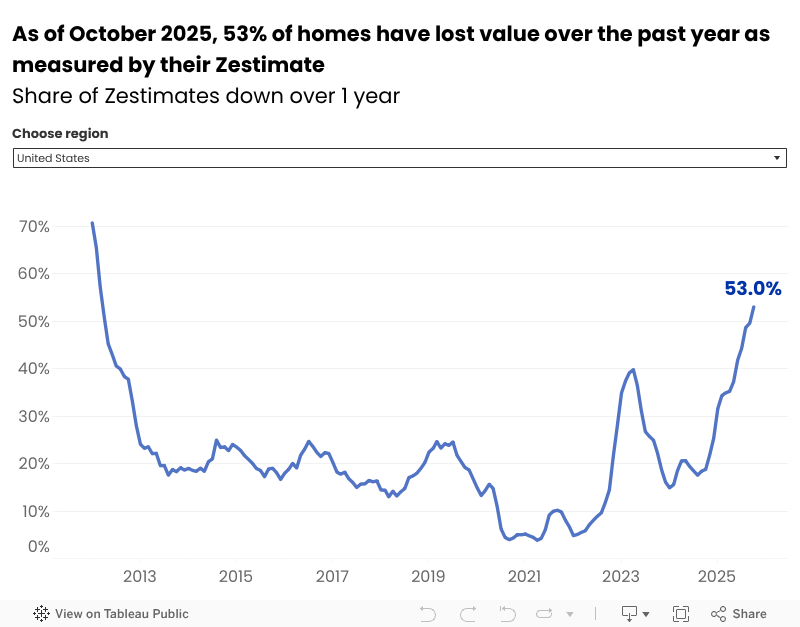
The U.S. housing market is experiencing a significant shift that hasn’t been seen in over a decade. With the home value declines spread across the country, according to recent data from Zillow, more than half of American homes have declined in value over the past year—marking the highest percentage since 2012. But before homeowners panic, there’s more to this story than meets the eye.
The Big Picture: Understanding the Numbers
This year has brought a noticeable correction to the housing market, with 53% of homes nationwide losing value compared to the previous year. This represents a dramatic reversal from the explosive growth seen during the pandemic years, when home prices surged to historic highs.
However, context is everything. Despite these recent declines, the vast majority of homeowners remain in strong financial positions. The median home has gained approximately 67% in value since it was last sold—typically around 8.5 years ago for the average homeowner. Only 4% of homeowners have lost value over their entire ownership period.
Where Are Values Declining Most?
The geographic pattern of these declines reveals important insights about regional housing dynamics:
Western and Southern Markets Lead Declines
The West and South have experienced the most widespread value losses, driven by two key factors: increased housing inventory and heightened climate-related risks. Cities that saw explosive pandemic-era growth are now experiencing the sharpest corrections:
- Denver: 91% of homes lost value (highest in the nation)
- Austin, Texas: 89% decline rate
- Sacramento, California: 88% decline rate
- Phoenix: 87% decline rate
- Dallas: 87% decline rate
- Portland, Oregon: 80% decline rate
These markets share common characteristics: they experienced dramatic price increases during 2020-2022, attracted significant migration, and now face affordability challenges that have cooled demand.
Midwest and Northeast Show Resilience
In contrast, most major metropolitan areas in the Northeast and Midwest have proven more stable. Only three major metros in these regions saw the majority of homes lose value:
- Minneapolis: 55%
- Des Moines, Iowa: 54%
- Scranton, Pennsylvania: 52%
This regional disparity highlights how local market conditions, inventory levels, and economic factors create vastly different outcomes even within a nationwide trend.

The Buyer’s Market That Few Can Access
Here’s the paradox of 2025’s housing market: it’s technically a buyer’s market, yet many potential buyers remain sidelined. The combination of persistently high mortgage rates—hovering near 7%—and elevated home prices has created a challenging environment for first-time buyers and move-up purchasers alike.
According to Redfin’s latest estimates, home sellers now outnumber buyers by a record 37% nationwide. This imbalance suggests that while opportunities exist for those with purchasing power, the pool of qualified and willing buyers has contracted significantly.
Understanding the Difference: Decline vs. Underwater
It’s crucial to distinguish between homes that have lost value and homes that are “underwater”—where the mortgage balance exceeds the property’s current worth.
As Zillow chief economist Mischa Fisher explains, far fewer homes are underwater today compared to 2019, despite recent value declines. This is because:
- Substantial equity cushions: Most homeowners built significant equity during the 2020-2022 boom
- Lower loan-to-value ratios: Many owners refinanced or made substantial principal payments during low-rate periods
- Shorter decline period: Current losses reflect only one year, not the multi-year collapse seen in 2008-2012
The data shows that losses between sales are up slightly from last year (from 2% to 4%) but remain well below pre-pandemic levels of 11%.
What’s Driving These Market Changes?
Several interconnected factors are reshaping home values across the country:
1. Inventory Normalization
Markets that experienced severe inventory shortages during the pandemic are now seeing more balanced supply. The West and South, in particular, have ramped up new construction, easing the pressure that drove prices to unsustainable levels.
2. Affordability Constraints
With median home prices still elevated and mortgage rates near multi-decade highs, monthly payments have become prohibitively expensive for many households. This has reduced buyer competition and given purchasers more negotiating leverage.
3. Remote Work Rebalancing
The initial pandemic-driven migration to Sun Belt cities and mountain states has moderated. Some workers are returning to offices, while others are reassessing whether remote work justifies higher housing costs in previously “affordable” markets that have become expensive.
4. Climate Risk Awareness
Growing recognition of climate-related risks—wildfires in California, hurricanes in coastal areas, extreme heat in the Southwest—is beginning to factor into buyer decisions and insurance costs, particularly affecting vulnerable markets.
What This Means for Homeowners
If you’re a current homeowner watching your estimated home value fluctuate, here’s what you should know:
Maximize Your Equity by Minimizing Costs
In a market where values are adjusting, protecting your equity becomes even more critical. Traditional real estate commissions—typically 5-6% of your sale price—can consume tens of thousands of dollars that rightfully belong in your pocket.
Sell smarter
List your home on the MLS for $99
No listing agent, no 3% commission. Beycome handles your MLS listing so you keep more of what your home is worth.
Sell your home →Buy smarter
Get up to 2% back at closing
Buy any home with a Beycome agent and receive a rebate of up to 2% of the purchase price — paid to you at closing.
Buy a home →Consider this: on a $400,000 home, a 6% commission equals $24,000. In today’s market, that could represent more than your entire year’s price appreciation—or worse, it could turn a small gain into a net loss after closing costs.
This is where technology-driven platforms like Beycome are revolutionizing home sales. By replacing traditional commission structures with flat-fee services and AI-powered tools, homeowners can save significantly:
- 18,500+ properties successfully closed through our platform
- $215+ million in total commissions saved by homeowners
- Average savings of $11,732 per transaction
- One property sold every 40 minutes using our technology
Instead of paying a percentage of your home’s value, you get full MLS exposure, professional marketing tools, legal contracts, and expert support for a flat fee—keeping more of your hard-earned equity where it belongs.
Don’t Panic Over Short-Term Fluctuations
Year-over-year declines, while notable, don’t erase the substantial gains most homeowners have accumulated. If you bought before 2020, you likely still have significant equity in your property—and protecting that equity from unnecessary commission costs is more important than ever.
Consider Your Timeline
Real estate remains a long-term investment. If you don’t need to sell immediately, these value adjustments may be temporary corrections rather than the beginning of a prolonged decline.
Location Still Matters
The market isn’t monolithic. While some cities see widespread declines, others remain stable or are still appreciating. Your specific neighborhood’s desirability, school quality, and local economic conditions matter more than national headlines.
Equity Is Your Safety Net
Even with recent declines, most homeowners can still leverage accumulated equity for renovations, debt consolidation, or other financial needs—a luxury that wasn’t available during the 2008 housing crisis.
Opportunities for Buyers in 2025
For those with the financial means to purchase, this market shift creates opportunities:
More Negotiating Power
With sellers outnumbering buyers, purchasers can negotiate on price, request repairs, and secure concessions that weren’t possible during the frenzied pandemic market.
Less Competition
Multiple-offer situations have become less common in many markets, allowing buyers time to conduct thorough due diligence rather than rushing into decisions.
Realistic Pricing
Sellers are increasingly accepting that 2021-2022 prices aren’t sustainable, leading to more reasonable asking prices and fewer overpriced listings.
Looking Ahead: What to Expect in 2026
While predicting real estate markets is notoriously difficult, several factors will likely shape the coming year:
Potential Rate Relief
If the Federal Reserve continues to cut rates as inflation moderates, mortgage rates could decline, potentially reinvigorating buyer demand and stabilizing prices.
Regional Divergence
Expect continued disparities between markets. Sun Belt cities with high inventory may continue adjusting, while supply-constrained coastal markets could stabilize or even appreciate.
Affordability Remains Central
Until the fundamental affordability crisis is addressed—through income growth, rate reductions, or price corrections—the market will likely remain challenging for many would-be buyers.
The Bottom Line
The current market correction, while significant, doesn’t signal a crisis comparable to 2008. Most homeowners retain substantial equity, underwater homes remain rare, and the declines reflect a normalization after unprecedented pandemic-era growth rather than a fundamental market collapse.
For sellers, this environment requires realistic pricing and patience—but it also demands smart cost management. When home values are under pressure, paying 5-6% in traditional commissions can dramatically reduce your net proceeds. By leveraging technology platforms that replace commission with flat-fee services, you can protect your equity and maximize your return even in a cooling market.
The Math Is Simple: A $400,000 home sale with traditional 6% commission leaves you with $376,000 after fees. The same sale with Beycome’s flat-fee model saves you approximately $20,000—money that stays in your pocket for your next down payment, retirement, or financial goals.
For buyers, opportunities exist but require strong financial positioning. And for existing homeowners not planning to move, these fluctuations are largely academic—your home’s value matters most when you actually decide to sell, and how much of that value you keep depends on the selling strategy you choose.
The key takeaway? Context matters. A 53% decline rate sounds alarming in a headline, but for the typical homeowner sitting on 67% gains since purchase, it represents a modest correction to an overheated market, not a financial catastrophe. And with smart, tech-driven selling solutions, you can ensure that more of your accumulated equity goes toward your future, not unnecessary commissions.
Protect Your Equity in Today’s Market
In a cooling market, every dollar of your home equity matters. Traditional real estate commissions can cost you $15,000-$30,000 or more—money that could be your down payment, retirement fund, or financial security.
Beycome replaces commission with technology. Our AI-powered platform gives you everything traditional agents offer—MLS listing, marketing tools, contracts, and support—for a fraction of the cost.
Our Track Record:
- ✅ 18,180+ homes successfully sold
- ✅ $213.7 million saved in commissions
- ✅ 4.6★ rating from 1,645 reviews
- ✅ One home sold every 40 minutes
Start Saving Today:
Get Your Free Home Valuation → Find Out What Your Home Is Worth
Ready to Sell? List on MLS for just $99 and keep thousands more → Start Here
Looking to Buy? Get 2% cash back on your purchase → Learn More about beycome buyer program