
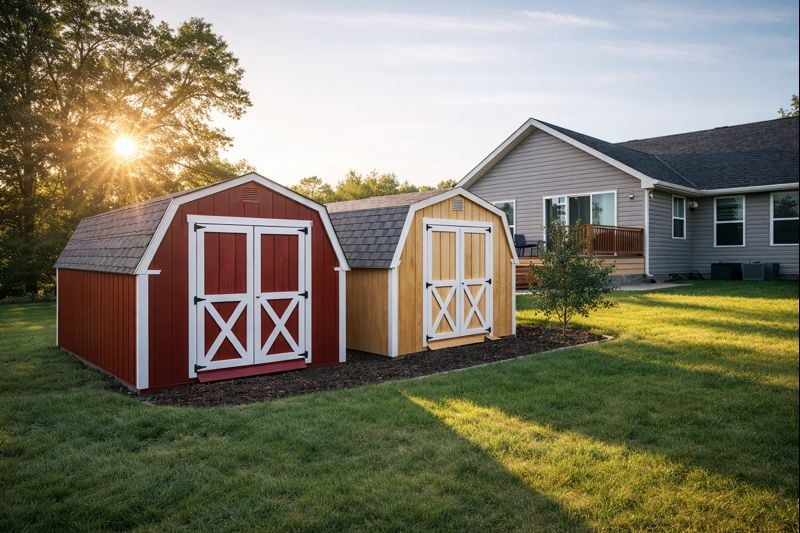
Updated November 2026. A storage barn is a shed with better marketing. Either way, here’s what one does for your home’s value when it’s time to sell.
A shed usually adds little appraised value, but it can help a home sell. As of November 2026, Fannie Mae’s guide keeps detached finished space out of a home’s finished area and has appraisers adjust a small outbuilding by what it contributes. Permit, condition and foundation all matter, and the 2024 model code exempts most sheds of 200 square feet or less.
Jump to: 🏠 Value · 📏 Square footage · 📋 Permits · 🚚 Does it stay? · 📸 Listing it · ❓ FAQ
Sheds and resale
- Buyers may like a shed more than an appraiser does, so it can speed a sale without raising the appraisal.
- A detached shed doesn’t count toward your finished square footage.
- A permit exemption doesn’t excuse you from zoning or setback rules.
- A shed on skids may be personal property, so say in writing whether it stays.
Sheds get bought for practical reasons: the mower, the kayaks, the bikes that won’t fit in the garage. Then you go to sell, and you wonder if that box out back shows up in your price. Sometimes. Less often than the shed salesperson hinted. If you’ve got something bigger, like a pole building, our page on how much a pole barn adds is closer to your question.
Does a shed add value to a home?
A little, in most cases. Appraisers value what comparable sales show buyers will pay for. If nearby homes with sheds don’t sell for more, yours probably won’t either.
| Shed | Likely effect on appraisal | Likely effect on buyers |
|---|---|---|
| Small, on skids, older | Little or none | Neutral; can look like clutter |
| Well kept, matching the house | Small, if local sales support it | Positive, especially without a garage |
| Permanent, permitted, with power | Some, depending on local sales | Positive; useful as a workshop |
| Falling apart | None, or a negative note | A cost to remove |
That table is our plain-English reading, and there’s no national price list for sheds. Fannie Mae’s Selling Guide says a standalone structure that doesn’t meet accessory dwelling minimums is treated as an ancillary structure and adjusted based on its contributory value. Small barns are fine when similar nearby homes have them. If an outbuilding is unusual for the area, it’s acceptable when the appraiser assigns it little or no value. For the bigger picture, see what an appraiser actually values.
Does a shed count as square footage?
No. Fannie Mae requires appraisers to measure homes under the ANSI standard, and detached structures with finished area go “on a different line in the adjustment grid,” outside the home’s finished area and room count.
So a 200-square-foot finished shed doesn’t turn your 1,500-square-foot home into 1,700. Don’t write it that way in a listing either. Our guide to what counts as square footage covers the rules for basements, additions and the like. Very large barns or animal buildings raise another question: lenders must review whether the property is still residential.
Do you need a permit for a shed?
Often not for a small one, but ask first. The 2024 International Residential Code exempts one-story detached accessory structures of 200 square feet or less from a building permit. It’s a model code, so your town may have changed it. Howard County, Maryland, for example, adds a limit on eave height.
The exemption covers only the permit. You still have to meet zoning, setback and any HOA rules. Electrical work typically needs its own review. And before anyone digs for a slab or footing, call 811, before you dig.
Why does this matter when you sell? A buyer’s inspector or title examiner might ask. An unpermitted shed that breaks setback rules is much easier to fix now than during a contract. Our garden workshop guide covers sizes and permits in more detail.
Does a shed stay with the house when you sell?
It depends on how it’s attached and what the contract says. A building fixed to a foundation is generally part of the real estate. One on skids could be treated either way, and that’s where sellers and buyers end up arguing on moving day.
Settle it in writing. List the shed as included or excluded in your purchase contract, along with anything inside it. If it’s included, say so in your listing as well. Taking it with you? Tell buyers up front, and repair the ground where it stood. And if your home’s condition is a concern more generally, look at which defects block a mortgage.
Sell smarter
List your home on the MLS from $99
A flat fee instead of a percentage, and $0 to Beycome at closing. You stay in control of your sale.
Sell your home →Buy smarter
Get up to 2% back at closing
On homes listed by other agents, Beycome credits you up to 2% of the price at closing (1% kept, $1,499 minimum; not on FSBO homes or homes listed by Beycome sellers).
Buy a home →How should you list a shed when you sell?
Show it, measure it, and describe what it does. Buyers remember “room for the mower and two bikes” better than “8×10 outbuilding.”
- Clear it out and sweep it, or at least make it look organized.
- Take one photo from outside and one from the door.
- Say whether it has power, and whether it’s permitted.
- Find the permit, the receipt and any warranty.
- Fix the door, the roof and any rot before buyers see it.
Beycome Basic lets you upload the maximum photos your MLS allows, so the shed doesn’t have to fight the kitchen for a slot. You can add or swap photos from your dashboard at any stage, and updates are free and unlimited. Your questionnaire takes you through the details, a complete file goes live on the MLS within 2 business days, and buyers book through ShowingTime where the MLS offers it.
Get on the major home search sites and the MLS from $99 in most states ($129 in California and Illinois), with $0 to Beycome at closing. Prefer an expert with you all the way? Concierge is $1,399, and you keep every decision. We’ve helped 22,000+ homeowners save over $225 million (Beycome internal data, October 2026).
Related reading and resources: Weaver storage barns, curb-appeal tips, NAR, 2025 Profile of Home Staging.
Shed and home value questions
Does a shed increase property taxes?
It can, particularly if it’s permanent. Assessors differ, so ask your county property appraiser or assessor before you build.
Will an appraiser include my shed?
They’ll note it if it’s part of the property. Any value depends on whether comparable sales nearby show buyers pay more for one.
Does a shed need a foundation to add value?
A permanent foundation makes it more likely to count as real estate. A shed on skids may add little, and could be treated as personal property.
Is a finished shed the same as an ADU?
No. An accessory dwelling has to meet minimums, such as being a separate living space. A shed that falls short is an ancillary structure.
Should I remove an old shed before selling?
If it’s rotting or leaning, usually yes. A falling-down shed is a cost in the buyer’s mind, and removal is often cheaper than repair.
Do I have to disclose an unpermitted shed?
Disclosure rules vary by state. If your form asks about permits or additions, answer truthfully, and ask an attorney if you’re unsure.
Prices as of November 2026 and subject to change. Basic from $99 in most states ($129 in California and Illinois), Concierge $1,399. “$0 at closing” means no Beycome fee at closing; taxes, title, escrow and any buyer-agent compensation you agree to still apply.
Appraisal treatment is decided by the appraiser and lender. Building rules are local. General information, not legal or appraisal advice.
Sources
- Fannie Mae Selling Guide, B4-1.3-05, Improvements Section of the Appraisal Report (updated June 4, 2025), read November 9, 2026.
- International Code Council, 2024 IRC, R105.2 work exempt from permit, seen in a search excerpt, November 9, 2026.
- Howard County, Maryland, adopted building code, 105.2, seen in a search excerpt, November 9, 2026.
- Beycome, listing package features, read November 9, 2026.
Disclosure & Disclaimer
Beycome provides real estate services through affiliated licensed brokerages and has a commercial interest in the services and business models discussed on this blog. Content reflects Beycome’s perspective and may promote our services; it should not be treated as independent or neutral reporting.
Articles are provided for general informational and educational purposes only, not as financial, tax, legal, or investment advice or a recommendation for your particular situation. Reading this blog does not create a brokerage, advisory, or other professional relationship.
Information, opinions, pricing, service descriptions, and comparisons reflect the sources and information available when an article was published or last updated and may change. Although we aim for accuracy, we do not guarantee that all content is complete, current, or applicable to your circumstances. Laws, market conditions, and service availability vary by location. Examples and estimated savings are illustrative, depend on stated assumptions, and do not guarantee individual results.
Verify relevant information directly and consult qualified professionals before making decisions. Beycome services are subject to applicable agreements, eligibility requirements, and state-specific terms.

