Updated October 2026. Code of Virginia sections, Real Estate Board forms and county recording fees checked on October 23, 2026.
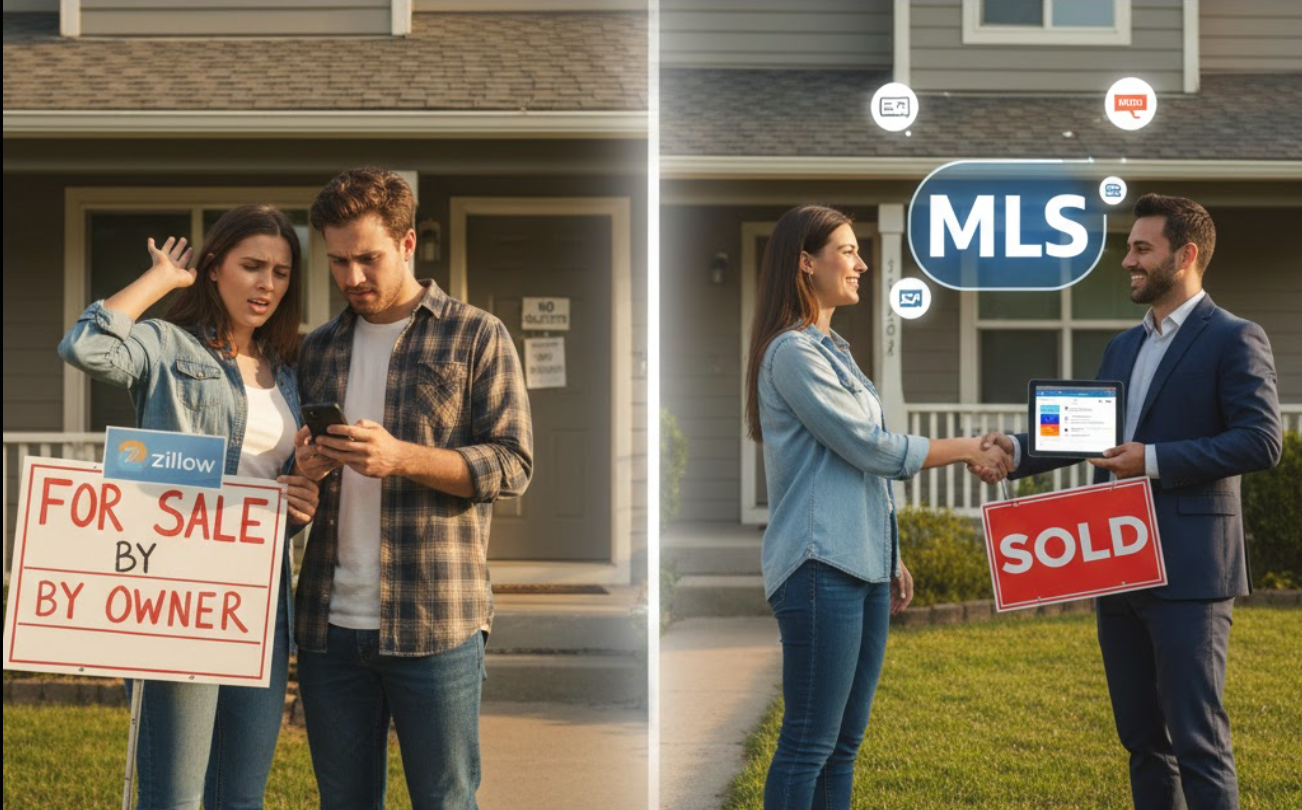
Yes, you can sell your house in Virginia without a realtor. As of October 2026, you give the buyer the Real Estate Board’s disclosure statement before the contract is ratified, pay the grantor’s tax of $0.50 per $500 ($412.50 on a $412,300 home), and close with the settlement agent the buyer picks. A flat fee broker can still put you on Bright MLS, CVRMLS or another Virginia MLS: Beycome Basic is $99, with $0 at closing.
Jump to: 🪜 Steps · 📍 Virginia rules · 💲 Costs · 🤝 Closing · ❓ FAQ
Virginia key takeaways
- The typical Virginia home value was $412,300 in September 2026, up 2.1% over the year (Zillow Home Value Index). A 3% listing fee on it would be $12,369.
- The seller pays the grantor’s tax. In Northern Virginia, two regional fees add $0.20 per $100, so the seller’s total on $412,300 is $1,237.10.
- Virginia is a buyer-beware state, but the disclosure forms are still mandatory. If they arrive after ratification, the buyer can cancel within 3 days (5 days if mailed).
- The buyer chooses the settlement agent by law. You can’t require a particular one.
How do you sell a house by owner in Virginia?
The basic steps are the same everywhere. What changes in Virginia is the paperwork before the contract and who runs the closing. Here’s the order we’d follow.
- Download the Residential Property Disclosure Statement and the acknowledgement form from the Real Estate Board’s page on the DPOR website.
- If you’re in a condo or HOA, order the resale certificate from the association early. You pay for it.
- Price from recent nearby sales. Our home value calculator gives you a starting range.
- List on the MLS that covers your county, so buyers’ agents and the big portals see the home.
- Give the disclosures to buyers before you ratify a contract.
- Negotiate price, deposit, contingencies and the settlement date.
- Sign the deed at settlement. The grantor’s tax is paid and the circuit court clerk records the deed.
New to this? Start with our hub on how to sell a house by owner, then our paperwork checklist and FSBO contract guide.
Which MLS covers your part of Virginia?
Virginia doesn’t have one MLS. It has several regional ones, and the right one depends on your county. Beycome lists on these (Beycome internal data, October 2026):
- Bright MLS, for Northern Virginia, including Arlington, Fairfax, Loudoun and Prince William.
- Central Virginia Regional MLS (CVRMLS), for Richmond, Henrico and Chesterfield.
- REIN MLS, through CVRMLS, for Hampton Roads: Virginia Beach, Norfolk, Chesapeake and nearby cities.
- Charlottesville Area MLS (CAAR), for Charlottesville and Albemarle.
- The Roanoke Valley MLS, Southwest Virginia MLS and Lynchburg MLS, for the west and southwest.
- My State MLS Virginia, a statewide option.
Values swing a lot across the state. In September 2026, Zillow put the typical home at $801,800 in Arlington, $424,800 in Virginia Beach, $361,800 in Richmond and $277,500 in Roanoke. That’s why the MLS matters: it’s where local buyers’ agents look first. Our guide to listing on the MLS without a realtor explains how a flat fee listing works.
What does Virginia law require from a seller?
The disclosure statement: buyer beware, in writing
The Virginia Residential Property Disclosure Act (Va. Code § 55.1-700 and following) asks for something unusual. Under § 55.1-703, you give the buyer a statement saying you make no representations about the home’s condition, lot lines, nearby parcels, flood zones, radon, defective drywall and more. The buyer is told to do their own checks, like a home inspection and a survey.
So it’s short, but it isn’t optional. The Real Estate Board posts the current form on DPOR’s disclosure page; the version listed today is effective July 1, 2026. Sellers must also complete the acknowledgement form and get the Flood Risk Information Form to the buyer.
Things you must disclose if you know them
A few facts override the “no representations” approach. If you have actual knowledge, you disclose it on the Board’s form:
- Pending building code enforcement or unremedied zoning violations you were notified of in writing (§ 55.1-706).
- Past use of the home to make methamphetamine, if it wasn’t cleaned up to state guidelines (§ 55.1-708).
- A privately owned stormwater facility and its maintenance duties (§ 55.1-708.1).
- Repetitive flood loss: two or more flood insurance claims over $1,000 within any rolling 10-year period since 1978 (§ 55.1-708.2).
Near a military air base, § 55.1-704 adds a form saying whether the parcel sits in a noise or accident potential zone. And under § 55.1-711, any material change must be disclosed at or before settlement.
Timing, and what happens if you’re late
Under § 55.1-709, the disclosures are due before the contract is ratified. If they come later, the buyer’s only remedy is to terminate. That right lasts 3 days after in-person or electronic delivery, or 5 days after the postmark if mailed. It ends sooner at settlement, occupancy, a loan application that warns about it, or a separate written waiver.
Condos and HOAs: the resale certificate
If your home is in a common interest community, the contract has to say so. You must get a resale certificate from the association for the buyer (§ 55.1-2308). The seller pays the fees to prepare and deliver it (§ 55.1-2316). Unless the contract sets another period, the buyer can cancel within 3 days of getting it (§ 55.1-2312).
Lead paint for older homes
For homes built before 1978, federal rules add the lead-based paint disclosure and the EPA pamphlet. Buyers get a 10-day window to test, unless they agree in writing to change or waive it.
How much does it cost to sell a house in Virginia?
Here’s the math on $412,300, the typical Virginia home value in September 2026 (Zillow Home Value Index). Tax rates come from the Code of Virginia and the Prince William County circuit court’s fee page, read October 23, 2026.
| Cost | Who pays | On a typical $412,300 home | Rule |
|---|---|---|---|
| MLS listing | Seller | $99 with Beycome Basic | $0 at closing; a 3% listing fee would be $12,369 |
| Grantor’s tax | Seller, by law | $412.50 | § 58.1-802: $0.50 per $500 or part of $500 |
| Regional congestion relief fee | Seller, by law | $412.30 (Northern Virginia only) | § 58.1-802.4: $0.10 per $100 |
| Regional WMATA capital fee | Seller, by law | $412.30 (Northern Virginia only) | § 58.1-802.3: $0.10 per $100 |
| State recordation tax | Buyer, typically | $1,030.75 | § 58.1-801: $0.25 per $100 |
| Local recordation tax | Buyer, typically | $343.58 | § 58.1-3800: one-third of the state tax |
| HOA or condo resale certificate | Seller, by law | Capped by the CIC Board | § 55.1-2316 |
| Buyer’s agent pay | Only if you agree | Negotiable | Not on the MLS since August 17, 2024 |
The grantor’s tax and both regional fees can be shifted to the buyer by agreement; the statutes allow it. The City of Alexandria’s recordation page says the state and local recordation taxes are paid by the purchaser. Outside Northern Virginia, the seller’s tax on $412,300 is just $412.50. Inside it, add $824.60 for the two regional fees, for $1,237.10 in all.
On an Arlington home at Zillow’s $801,800 typical value, the seller’s side is $802 in grantor’s tax plus $1,603.60 in regional fees: $2,405.60. To compare costs across states, see our 2026 commission guide by state.
Who handles the closing in Virginia?
The buyer picks. Va. Code § 55.1-1007 requires every contract for a home with up to four units to say, in bold, that the purchaser or borrower has the right to select the settlement agent. It also says the seller may not require a particular settlement agent as a condition of the sale.
Sell smarter
List your home on the MLS for $99
No listing agent, no 3% commission. Beycome handles your MLS listing so you keep more of what your home is worth.
Sell your home →Buy smarter
Get up to 2% back at closing
Buy any home with a Beycome agent and receive a rebate of up to 2% of the purchase price — paid to you at closing.
Buy a home →Under § 55.1-1003, a settlement agent can be a lawyer, a title company, a licensed title agent, a broker or a bank. They handle title, payoffs and the money. They can’t give you legal advice unless they’re a Virginia lawyer you’ve hired, so hire your own attorney if you want help with the deed or contract.
Do you need a realtor to sell in Virginia?
No, it’s not required; it’s your choice. Both paths work. A listing agent prices the home, runs showings, negotiates and keeps the paperwork on schedule, and you pay for that service. Selling yourself, you handle those parts and keep the fee. The state forms and the settlement steps are the same either way.
With Beycome Basic, Artur, our AI assistant, helps you read and answer offers, and you get e-signature, unlimited listing changes and ShowingTime where your MLS offers it. Your listing stays up for the maximum the state and MLS allow**, and you can cancel free* before you’re under contract. If you’d like a person to negotiate while you keep every decision, Beycome Concierge is $999 through October 31, 2026 (list price $1,399); from November 1, 2026, it’s $1,399. Either way, it’s $0 at closing.
Buying your next home too? Our buyer program is open to every buyer on homes listed by other agents. Beycome keeps 1% (minimum $1,499) and credits the rest of the buyer-agent commission to you at closing (the commission credit can’t apply where no buyer-agent commission is offered, like most FSBO homes, or on homes listed by Beycome sellers). Need your parcel number for the listing? Here’s how to find your Virginia property tax ID. When you’re ready, start on our Virginia flat fee MLS page.
Virginia FSBO questions
Can I sell my house in Virginia without a realtor?
Yes. Owners can sell their own homes in Virginia. You still deliver the Real Estate Board’s disclosure forms before the contract is ratified, and a settlement agent chosen by the buyer handles the closing.
Who pays the grantor’s tax in Virginia?
The seller, under Va. Code § 58.1-802, unless the contract shifts it. It’s $0.50 per $500 of price, or $412.50 on a $412,300 home.
What extra fees apply in Northern Virginia?
Two regional fees paid by the seller: the congestion relief fee and the WMATA capital fee, each $0.10 per $100. On $412,300, that’s $824.60 on top of the grantor’s tax.
Do I need a lawyer to sell my house in Virginia?
Not by law. The buyer picks the settlement agent, which can be a title company, a title agent or a lawyer. That agent can’t give you legal advice, so hire your own attorney if you want one.
Is Virginia a disclosure state?
It’s buyer beware, but disclosure forms are still required. You give a statement that you make no representations, plus specific disclosures if you know of things like flood claims or code violations.
Can I list my Virginia home on the MLS without an agent?
Yes, through a flat fee broker. Beycome lists on Bright MLS, CVRMLS, REIN via CVRMLS, CAAR, Roanoke Valley, Southwest Virginia, Lynchburg and My State MLS Virginia for $99, with $0 at closing.
Do I have to pay the buyer’s agent in Virginia?
No. It’s your choice and fully negotiable, and since August 17, 2024 it can’t be offered on the MLS.
Reviewed by Beycome Brokerage Realty LLC, licensed real estate brokerage (VA #0226039625). Licenses: beycome.com/faq/how-to/are-you-a-licensed-broker/.
Commission figures are examples only. Real estate commissions are not set by law or by NAR rules and are fully negotiable. Sellers choose whether to offer any compensation to a buyer’s agent, and how much; since August 17, 2024, those offers can’t be shown on the MLS.
Prices are as of October 2026. Concierge is $999 through October 31, 2026, and $1,399 from November 1, 2026; Basic stays $99 in Virginia. “$0 at closing” means no Beycome fee at closing. Taxes, settlement fees and any buyer’s agent pay you agree to still apply.
* Cancel free: no Beycome cancellation fee. Listings under contract can’t be canceled. No refund once the listing is live.
** Listing term is the maximum the state and MLS allow: 24 months in Virginia (12 months in Maryland and Pennsylvania).
Buyer credit: Beycome keeps 1% of the price (minimum $1,499); the credit needs lender approval and applies only where a buyer-agent commission is offered.
This is general information, not legal or tax advice. Rules vary by state and by MLS, so check with a Virginia real estate attorney for your situation.
Sources
- Code of Virginia, Virginia Residential Property Disclosure Act, §§ 55.1-702 to 55.1-711 (read October 23, 2026): law.lis.virginia.gov.
- Code of Virginia, § 55.1-709, time for disclosure and termination: law.lis.virginia.gov.
- Virginia DPOR, Real Estate Board disclosure forms (read October 23, 2026): dpor.virginia.gov.
- Code of Virginia, §§ 55.1-2308, 55.1-2312 and 55.1-2316, resale certificates: law.lis.virginia.gov.
- Code of Virginia, §§ 58.1-801, 58.1-802, 58.1-802.3 and 58.1-802.4, recordation and grantor taxes: law.lis.virginia.gov.
- Code of Virginia, § 58.1-3800, local recordation tax: law.lis.virginia.gov.
- Prince William County Circuit Court, Land Records Fees (read October 23, 2026): pwcva.gov.
- City of Alexandria, Recordation Tax (read October 23, 2026): alexandriava.gov.
- Code of Virginia, §§ 55.1-1003 and 55.1-1007, settlement agents: law.lis.virginia.gov.
- EPA, Real Estate Disclosures About Potential Lead Hazards: epa.gov.
- NAR, Settlement FAQs: nar.realtor.
- Zillow Research, Zillow Home Value Index (September 2026): zillow.com.
- Beycome, listing package features, October 2026.
Disclosure & Disclaimer
Beycome provides real estate services through affiliated licensed brokerages and has a commercial interest in the services and business models discussed on this blog. Content reflects Beycome’s perspective and may promote our services; it should not be treated as independent or neutral reporting.
Articles are provided for general informational and educational purposes only, not as financial, tax, legal, or investment advice or a recommendation for your particular situation. Reading this blog does not create a brokerage, advisory, or other professional relationship.
Information, opinions, pricing, service descriptions, and comparisons reflect the sources and information available when an article was published or last updated and may change. Although we aim for accuracy, we do not guarantee that all content is complete, current, or applicable to your circumstances. Laws, market conditions, and service availability vary by location. Examples and estimated savings are illustrative, depend on stated assumptions, and do not guarantee individual results.
Verify relevant information directly and consult qualified professionals before making decisions. Beycome services are subject to applicable agreements, eligibility requirements, and state-specific terms.