
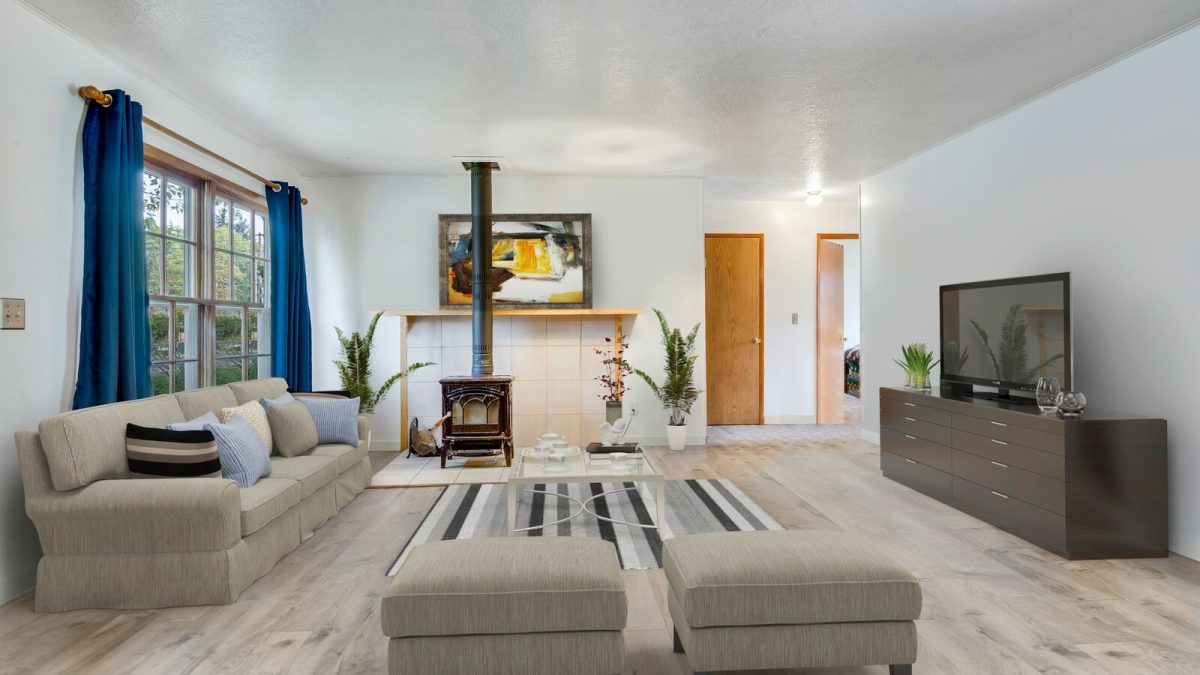
Updated November 2026. For US owners, landlords and commercial owners marketing a vacant space, and anyone choosing between virtual and real staging.
Real estate virtual staging in the United States adds digital furniture to photos of empty rooms, and it’s legal as long as the photos don’t mislead. In NAR’s 2025 Profile of Home Staging, 83% of buyers’ agents said staging helps buyers picture a home. As of November 2026, California’s AB 723 also makes licensees label altered listing photos.
For homes that aren’t built yet, developers use a real estate rendering company instead. Virtual staging costs far less than renting furniture, and it’s quick to redo.
Jump to: 🪜 How it works · 🏠 When to use it · 🇺🇸 US rules · 📍 Disclosure rules · 💲 Virtual vs real staging · ❓ FAQ
Key takeaways
- 83% of buyers’ agents told NAR that staging helps buyers picture the home as their own (2025 survey).
- The rooms staged most often were the living room (91%), primary bedroom (83%) and dining room (69%).
- California’s AB 723 (2025) requires licensees to disclose digitally altered images and link to the unaltered original.
- Show buyers what’s real: stage furniture, never remove defects or change the view.
Most people know home staging: you bring in furniture and decor so a home shows well. It also costs time and money, and it’s hard to do in a vacant home far away. Virtual staging does the same job in the photos. Here’s how to use it well and stay on the right side of the rules.
How does virtual staging work?
- Take sharp, bright photos of the empty rooms, from the corners, at chest height.
- Send them to a virtual staging service or use staging software.
- A designer adds furniture, rugs, art and lighting, with shadows and reflections so it looks real.
- You review the drafts and pick a style that fits the home and the likely buyer.
- You publish the staged photos with a clear note, alongside the empty-room originals.
Good photos come first. Virtual staging can’t fix a dark, blurry shot. Most editors want an empty room, though many can digitally remove old furniture before staging it. On sites like Reddit, agents still debate whether Virtual Staging that looks fake is worth paying for. Their main point holds: cheap, cartoonish furniture can hurt more than help.
Shooting photos that stage well
Shoot in daylight with every light on and the blinds open. Clean the windows and floors, because the designer can’t fix dirt cheaply. Keep the camera level so walls stay straight. Take two angles of each main room, so you can pick the one that shows the most floor. And shoot the empty rooms even if you plan real staging later: you’ll want the originals for your disclosure.
With Beycome, every listing shows the most photos the MLS allows. Enhanced ($399) includes a shoot with 25 HD photos, and Basic sellers can add pro photos for $189. Start with a flat fee MLS listing, from $99 in most states (see your state page), with $0 at closing. Your staged photos then show on the major home search sites and the MLS.
When does virtual staging make sense?
Vacant homes
An empty room is hard to read in a photo. Buyers can’t tell if a queen bed fits, or where the sofa goes. Staged photos answer that in a second. This is the main use for staging vacant homes, whether you’ve moved out or the home is an estate sale.
Vacant homes need other care too: lights on timers, regular checks, locks changed. See our easy ways to protect and safeguard your vacant real estate.
Rentals and landlords
Virtual staging for landlords works the same way. A staged photo of an empty unit helps renters compare it with furnished listings nearby. Label it clearly, and show the empty version too.
Dated furniture
If your furniture is worn or very personal, a designer can replace it in the photos. Be careful here: the buyer will see your real furniture at the showing, so the gap shouldn’t be a shock.
Commercial virtual staging
Commercial virtual staging shows an empty office, shop or restaurant space with desks, shelving or tables. It helps a buyer or tenant see the layout, the seat count and how a team would fit. The same honesty rules apply: show the empty photo too, and don’t add windows, walls or finishes that aren’t there.
Does staging really help a home sell?
Agents say it does, at least for many buyers. NAR surveyed REALTORS® in February 2025 for its 2025 Profile of Home Staging. Here’s what it found.
| Finding (NAR, 2025) | Share |
|---|---|
| Buyers’ agents who said staging makes it easier to visualize the home | 83% |
| Buyers’ agents who said staging affected most buyers’ view of the home | 26% |
| Buyers’ agents who said it affected some buyers, but not always | 60% |
| Sellers’ agents who stage all their listings before listing | 21% |
| Living room is among the rooms staged | 91% |
| Primary bedroom | 83% |
| Dining room | 69% |
The lesson for virtual staging: focus on the rooms that matter. Stage the living room, the primary bedroom and the dining area first. A staged laundry room rarely moves anyone.
Is virtual staging legal in the United States?
Yes, in every state. No US law bans adding digital furniture to a listing photo. What the rules target is misleading buyers. Here’s which rule applies where, as of November 2026.
| Where | Rule | What it asks |
|---|---|---|
| California | AB 723, Business and Professions Code 10140.8 | Label altered images and link to the unaltered original |
| Every state, REALTORS® | NAR Code of Ethics, Article 12 | Present a true picture in ads, online images included |
| Your local MLS | MLS photo rules | Vary by MLS; check before you upload |
| Owners selling by owner | General honesty and disclosure duties | Don’t hide defects; label staged photos anyway |
The details for California and the Code of Ethics are below. If you sell in another state, labeling is still the safe habit.
Sell smarter
List your home on the MLS from $99
A flat fee instead of a percentage, and $0 to Beycome at closing. You stay in control of your sale.
Sell your home →Buy smarter
Get up to 2% back at closing
On homes listed by other agents, Beycome credits you up to 2% of the price at closing (1% kept, $1,499 minimum; not on FSBO homes or homes listed by Beycome sellers).
Buy a home →What are the disclosure rules for virtually staged photos?
Virtual staging is legal. Misleading buyers isn’t. Two sets of rules matter.
California’s AB 723
California’s Assembly Bill 723 was approved on October 10, 2025, adding section 10140.8 to the Business and Professions Code. It says a broker or salesperson, or someone acting for them, who uses a digitally altered image in an ad for a property must:
- Add a statement that the image has been altered, on or next to the image.
- Include a link, URL or QR code to the original, unaltered image.
- Post the unaltered versions on any website they control that shows the altered ones.
The law covers images changed with photo software or AI to add, remove or change things like furniture, appliances, flooring, paint color, landscaping or views through windows. Simple edits, like lighting, color correction, cropping or straightening, aren’t covered.
NAR’s Code of Ethics
Article 12 of the NAR Code of Ethics says REALTORS® must “present a true picture” in their advertising, including online images. MLSs also have their own photo rules, so check yours before you upload.
Our rules of thumb
- Label every staged photo with a short note that says it was virtually staged.
- Show the empty-room version right next to it.
- Add furniture only. Don’t remove cracks, stains, power lines or the neighbor’s wall.
- Don’t change paint, floors or the view unless you label it clearly as a design idea.
Virtual staging vs real staging: which should you choose?
| Virtual staging | Real staging | |
|---|---|---|
| Cost | Per photo; usually far less | Furniture rental, moving, monthly fees |
| Speed | Often days | Needs scheduling, delivery and setup |
| In-person showings | Rooms are still empty | Rooms look the same as the photos |
| Style changes | Easy to redo | Costly to change |
| Disclosure | Required in California for licensees; always wise | Not needed for real furniture |
A mix often works best: virtual staging for the photos, plus a few real pieces in the main room for showings. Our guide to staging a house to sell covers the real-furniture side, and virtual staging solutions for home appeal compares styles. A rug, two chairs and a lamp go a long way. Want to stage it yourself? Our DIY interior design tips help, and so does reading how interior design services can help you if you’d rather hire out.
How do you get the most from staged photos?
Lead with your strongest staged photo, usually the living room. Then tell the story in the listing text. Our guide to listing descriptions that attract buyers shows how. Tech keeps changing how homes are marketed; see 5 game-changing trends in real estate technology for sellers.
If you’d like someone to manage the paperwork once offers come in, read about what a real estate transaction coordinator does. Or have Beycome’s experts work with you on the sale through Beycome Concierge (see current price), with $0 at closing. You stay in control of every decision.
Frequently asked questions
Is virtual staging legal in the United States?
Yes. No US law bans it. California requires licensees to label altered photos and link the originals, and NAR’s Code asks REALTORS to present a true picture.
What is commercial virtual staging?
Digital furniture in photos of empty offices, shops or restaurants, so a buyer or tenant can see the layout and size. Label it like any staged photo.
What is virtual staging in real estate?
Adding furniture and decor to photos of empty rooms with design software, so buyers or renters can picture the space.
Is virtual staging worth it for a vacant home?
Usually, yes. 83% of buyers’ agents in NAR’s 2025 survey said staging helps buyers visualize a home, and empty rooms are the hardest to read in photos.
Do you have to disclose virtual staging?
In California, licensees must label digitally altered images and link to the originals under AB 723. Everywhere, labeling is the honest choice, and NAR’s Code requires a true picture.
Which rooms should I virtually stage?
Start with the living room, primary bedroom and dining room, the rooms agents stage most often per NAR.
Can landlords use virtual staging?
Yes. Label the photos and show the empty-room versions so renters aren’t surprised at the viewing.
Can virtual staging hide problems?
It shouldn’t. Add furniture only. Removing defects or changing views misleads buyers and, in California, triggers the altered-image rules.
Prices as of November 2026 and subject to change. Basic: from $99 in most states (see your state page). Concierge: see current price. “$0 at closing” means no Beycome fee at closing; other closing costs still apply. The Enhanced photo shoot is scheduled separately from the MLS go-live. General information, not legal advice; photo rules vary by state and MLS.
Sources
- NAR, 2025 Profile of Home Staging, read October 26, 2026.
- California AB 723 (2025), Chapter 497, digitally altered images, read October 26, 2026.
- NAR Code of Ethics and Standards of Practice, Article 12, read October 26, 2026.
- Beycome, listing package features, October 2026.
Disclosure & Disclaimer
Beycome provides real estate services through affiliated licensed brokerages and has a commercial interest in the services and business models discussed on this blog. Content reflects Beycome’s perspective and may promote our services; it should not be treated as independent or neutral reporting.
Articles are provided for general informational and educational purposes only, not as financial, tax, legal, or investment advice or a recommendation for your particular situation. Reading this blog does not create a brokerage, advisory, or other professional relationship.
Information, opinions, pricing, service descriptions, and comparisons reflect the sources and information available when an article was published or last updated and may change. Although we aim for accuracy, we do not guarantee that all content is complete, current, or applicable to your circumstances. Laws, market conditions, and service availability vary by location. Examples and estimated savings are illustrative, depend on stated assumptions, and do not guarantee individual results.
Verify relevant information directly and consult qualified professionals before making decisions. Beycome services are subject to applicable agreements, eligibility requirements, and state-specific terms.

