
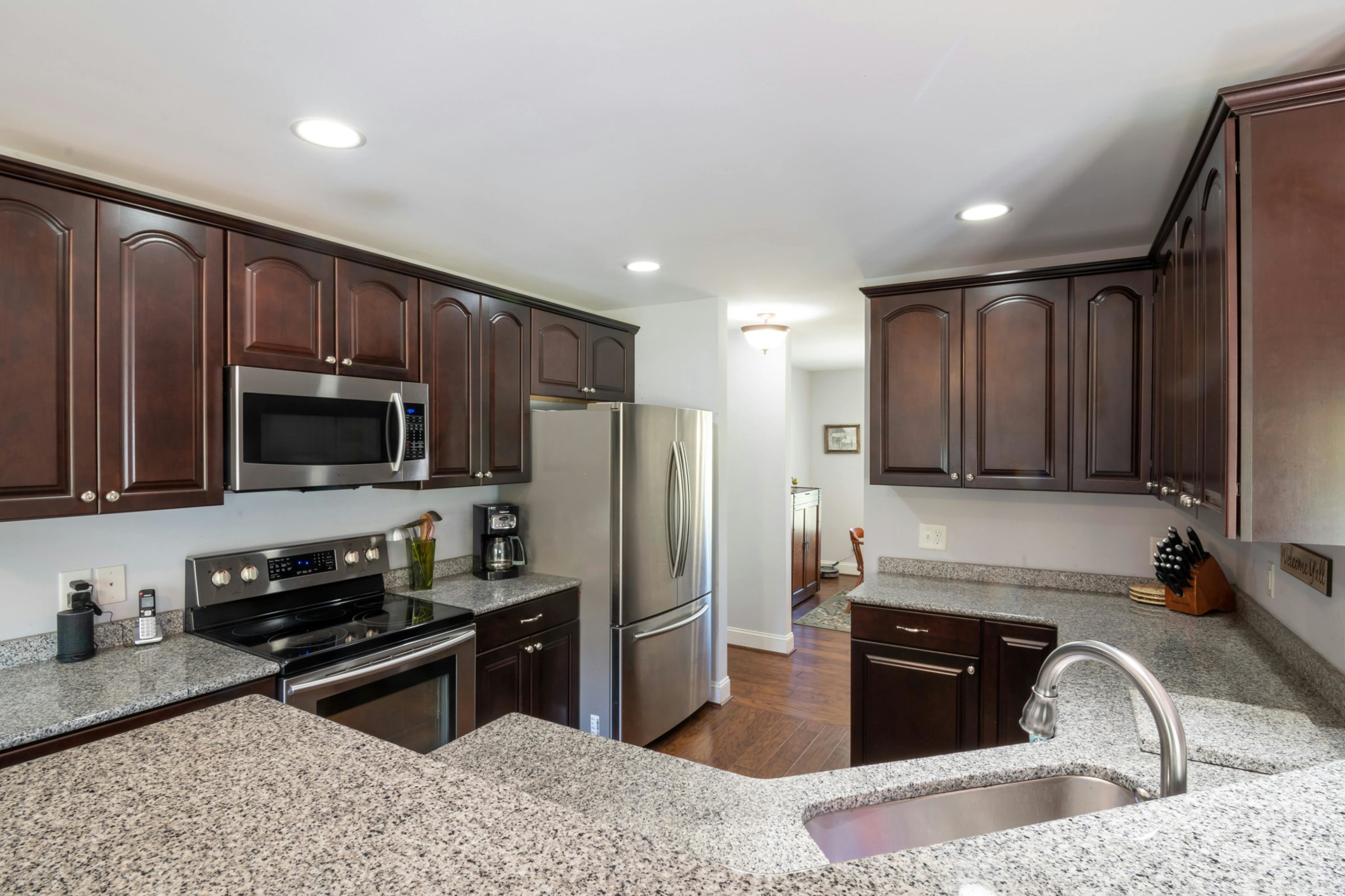
Updated October 2026. How to design kitchen cabinets that hold more: standard sizes, the reach zone, drawers versus doors, corners, tall pantries and the box details that decide how much fits. Sources read October 30, 2026.
Smartly designed kitchen cabinets store more by putting the most-used items between 15 and 48 inches off the floor (the ADA reach range), using deep drawers instead of doors in base cabinets, and solving the corners. Standard base cabinets are 34.5 inches tall and 24 inches deep (36 inches with the counter), so every inch of width and height you plan counts.
Jump to: 📸 Standard sizes · 🪜 Reach zone · 🏠 Drawers vs doors · ⏱️ Corners and gaps · 💲 Box details · ❓ FAQ
Cabinet storage rules of thumb
- Base cabinets: 34.5 inches tall, 24 inches deep, 12 to 48 inches wide; wall cabinets 12 to 24 inches deep (Mr. Handyman sizing guide).
- Keep daily items in the 15 to 48 inch band, the forward reach range in the 2010 ADA Standards.
- Drawers let you see and reach the back of a 24-inch-deep base; doors with fixed shelves don’t.
- KCMA’s A161.1 seal means a cabinet passed tests for structure, drawer and door integrity and finish.
Most kitchens don’t lack cabinets. They lack cabinets that work. A 24-inch-deep base with one fixed shelf hides half its contents in the dark. An upper cabinet that runs to the ceiling has a top shelf nobody can reach. Small design choices fix both, and they cost far less than adding square footage. For the bigger picture of planning the room, see our modern kitchen design principles and makeover checklist.
What are standard kitchen cabinet sizes?
Stock and semi-custom lines follow a common set of sizes, which makes planning easier. Mr. Handyman’s sizing guide lists:
| Cabinet type | Height | Depth | Width |
|---|---|---|---|
| Base | 34.5 in (36 in with counter) | 24 in | 12 to 48 in |
| Wall (upper) | 12 to 42 in | 12 to 24 in | 12 to 36 in |
| Tall (pantry) | Often 84 to 96 in | Varies, often 12 or 24 in | Varies |
Widths usually come in 3-inch steps. That matters when you have an odd wall. Instead of a wide filler strip, look at whether a 9-inch or 12-inch pull-out fits the gap. A filler is wasted space; a narrow pull-out holds oils, sheet pans or cutting boards.
Upper cabinet depth is a trade-off. Deeper uppers hold dinner plates and big bowls, but they crowd the counter and your head. Most kitchens keep uppers at 12 inches and put bulky items in base drawers or a pantry. Measure your largest plates before you order.
Where should you put the things you use most?
In the zone you can reach without a step stool or a deep crouch. The 2010 ADA Standards set the unobstructed forward reach range at 15 inches minimum and 48 inches maximum above the floor. They’re written for public spaces, not your house, but the range is a good guide for anyone.
In a standard kitchen, that band runs from just above the toe kick to about the second shelf of an upper cabinet. So:
- Daily dishes and glasses go in the lower shelves of uppers or in top base drawers.
- Pots and pans go in deep base drawers, not in the back of a dark cupboard.
- Holiday platters, the turkey roaster and spare paper towels go up high or down low.
- Heavy appliances live at counter height or just below, never overhead.
Stacked upper cabinets, with a short row on top, look good and add storage. Use them for things you reach a few times a year. If you’re tall or short, adjust the plan to your own reach, not the catalog’s.
Are drawers better than doors for base cabinets?
For most base cabinets, yes. A drawer pulls the back of the cabinet out to you. A door with a fixed shelf makes you kneel and dig. That’s why many current kitchens use banks of drawers for everything except the sink base.
Plan the drawer heights around what goes in them. A shallow top drawer for utensils, a medium drawer for storage containers and two deep drawers for pots is a common bank. Ask for full-extension slides so the drawer comes all the way out, and soft-close if you have kids who slam things.
Where you keep doors, add roll-out shelves behind them. They give you most of a drawer’s access while keeping a door front. For the sink base, a U-shaped drawer that wraps around the plumbing beats an empty box with a bucket of sponges.
How do you use corners and odd gaps?
Corners are where kitchens lose the most space. A blind corner cabinet can hide three feet of storage that nobody ever reaches. The options, roughly from cheapest to most expensive:
Sell smarter
List your home on the MLS from $99
A flat fee instead of a percentage, and $0 to Beycome at closing. You stay in control of your sale.
Sell your home →Buy smarter
Get up to 2% back at closing
On homes listed by other agents, Beycome credits you up to 2% of the price at closing (1% kept, $1,499 minimum; not on FSBO homes or homes listed by Beycome sellers).
Buy a home →- A lazy Susan in a diagonal or L-shaped corner base.
- Pull-out blind corner units that swing shelves out into the open.
- Corner drawers that meet at a point, which work well for pans.
- Giving up the corner on purpose and using a wider drawer bank on each side.
Then hunt the small gaps. A toe-kick drawer under the base cabinets holds baking sheets or a step stool. A slim cabinet beside the range holds spices and oils within reach of the cooktop. A tray divider above the oven stores sheet pans on edge. A tall pantry with roll-out shelves often holds more than a wall of uppers in the same width.
If you’re hosting a crowd, the same thinking helps with temporary clutter; see how to organize space when guests are coming over. And for everyday calm, our easy organization ideas cover the rest of the house.
Which cabinet box details change how much fits?
Two cabinets with the same outside size can hold different amounts. Look at these before you choose a line:
- Frame or frameless. Face-frame cabinets have a solid border around the opening, which narrows it slightly. Frameless (European style) boxes give a wider opening and let drawers be a little wider inside.
- Shelf depth and adjustability. Adjustable shelves let you fit cereal boxes and stand mixers without wasted air above them.
- Drawer boxes. Dovetailed or doweled boxes with full-extension slides carry heavy pots better than stapled sides on side-mount runners.
- Materials and labels. Plywood and particleboard boxes both work if they stay dry. Composite panels sold in the US must carry a TSCA Title VI label for formaldehyde emissions (EPA).
- Certification. The Kitchen Cabinet Manufacturers Association’s A161.1 seal means the cabinet passed tests of structural strength, drawer and door integrity and finish durability.
For a deeper look at materials, grades and assembled versus ready-to-assemble boxes, see builder grade kitchen cabinets, assembled vs RTA cabinets and materials for a kitchen remodel.
Buying in bulk can lower the price per box. If you’re renovating or updating your kitchen storage on the West Coast, exploring wholesale cabinets in Los Angeles can turn up ready-to-assemble lines with pull-outs and organizers built in. Whatever you buy, ask for the interior options list, not just door styles.
Does smart cabinet storage help when you sell?
Buyers open cabinets. They open them at showings and they study them in listing photos. Drawers that glide, a pantry that’s tidy and corners that actually work make a kitchen feel bigger. Before photos, clear the counters and pull a third of the stuff out of the cabinets, so they look roomy rather than packed. Our kitchen layout advice helps you decide what’s worth doing first.
When you’re ready to list, Beycome puts your home on the major home search sites and the MLS from $99, and you owe Beycome $0 at closing. You stay in charge of price, showings and offers. See Beycome’s listing packages, and for timing tips, our home buying and selling strategies that work fast. Beycome has served 22,000+ homeowners, who saved over $225 million, and sees a home sold every 30 minutes (Beycome internal data, October 2026).
Kitchen cabinet storage questions
What is the standard depth of kitchen cabinets?
Base cabinets are usually 24 inches deep and 34.5 inches tall. Wall cabinets are commonly 12 inches deep, with a range of 12 to 24 inches.
Are drawers or cabinets better for kitchen storage?
Drawers usually win in base cabinets, because they bring the back of a deep cabinet out to you. Keep doors with roll-out shelves where drawers don’t fit.
How do you use a blind corner cabinet?
Add a pull-out corner unit or swing-out shelves, use a lazy Susan in an L-shaped corner, or skip the corner and widen the drawer banks beside it.
What height should everyday dishes be stored at?
Between about 15 and 48 inches off the floor, the forward reach range in the 2010 ADA Standards. Adjust for your own height.
Are frameless cabinets worth it for storage?
They give a wider opening because there’s no face frame around the box, which helps with drawers and large items. Face-frame cabinets are sturdy and common too.
What does KCMA certified mean?
The KCMA A161.1 seal means the cabinet passed tests for structural strength, drawer and door integrity and finish durability.
Cabinet sizes vary by manufacturer; check the spec sheet for your line. ADA reach figures come from the 2010 ADA Standards for Accessible Design (section 308.2.1), which apply to covered public facilities, not private homes; they are used here as a guide. Beycome prices as of October 2026; “$0 at closing” means no Beycome fee at closing (other closing costs and taxes still apply). General information only.
Sources
- Mr. Handyman, Guide to Standard Kitchen Cabinet Sizes, read October 30, 2026.
- U.S. Access Board, ADA Accessibility Standards (308 Reach Ranges), read October 30, 2026.
- KCMA, Cabinet Certifications, read October 30, 2026.
- EPA, Formaldehyde Emission Standards for Composite Wood Products, read October 30, 2026.
- Beycome, listing package features, October 2026.
Disclosure & Disclaimer
Beycome provides real estate services through affiliated licensed brokerages and has a commercial interest in the services and business models discussed on this blog. Content reflects Beycome’s perspective and may promote our services; it should not be treated as independent or neutral reporting.
Articles are provided for general informational and educational purposes only, not as financial, tax, legal, or investment advice or a recommendation for your particular situation. Reading this blog does not create a brokerage, advisory, or other professional relationship.
Information, opinions, pricing, service descriptions, and comparisons reflect the sources and information available when an article was published or last updated and may change. Although we aim for accuracy, we do not guarantee that all content is complete, current, or applicable to your circumstances. Laws, market conditions, and service availability vary by location. Examples and estimated savings are illustrative, depend on stated assumptions, and do not guarantee individual results.
Verify relevant information directly and consult qualified professionals before making decisions. Beycome services are subject to applicable agreements, eligibility requirements, and state-specific terms.

