
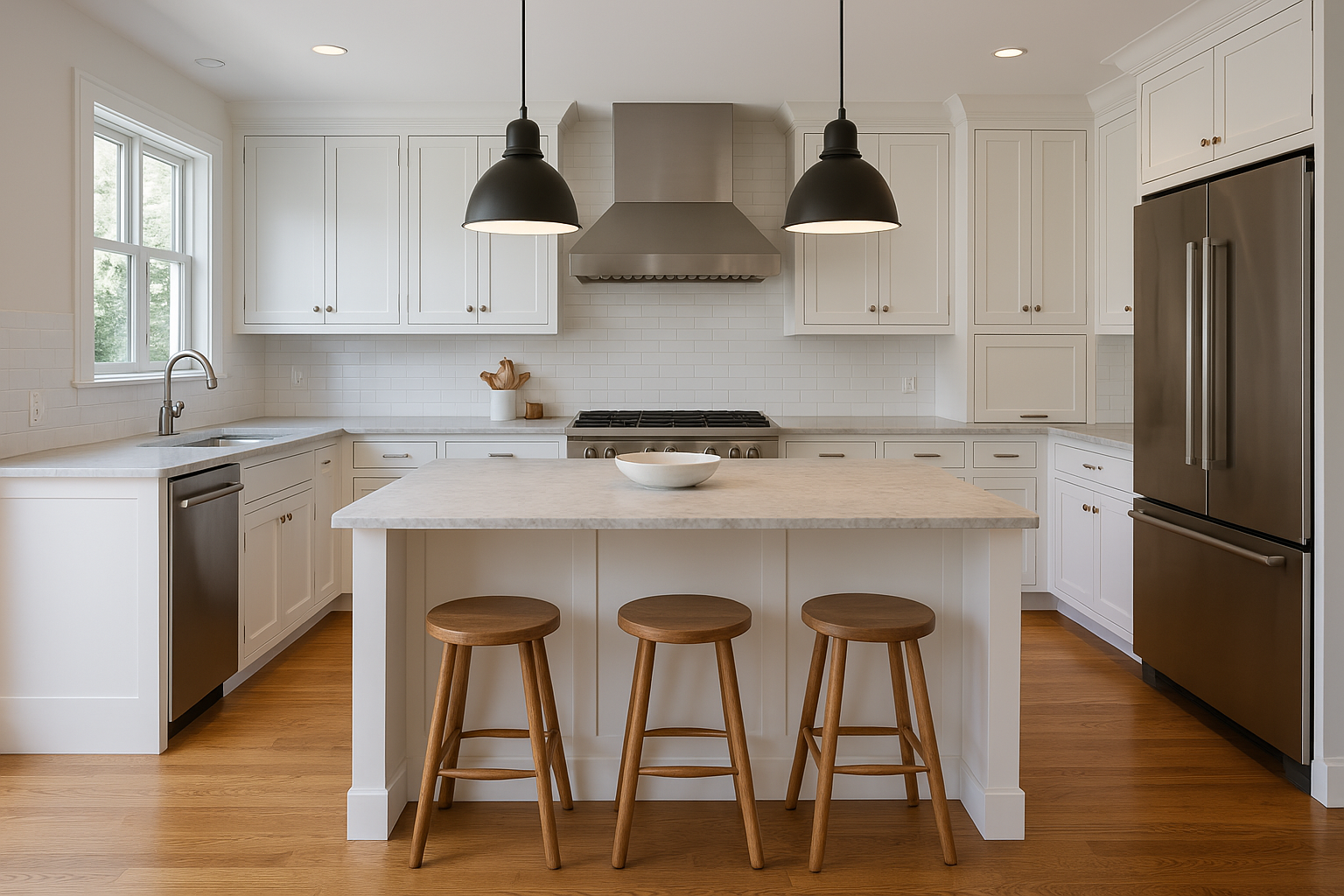
Updated November 2026. For owners of newer homes, buyers touring new construction, and sellers deciding whether to replace a kitchen before listing.
Builder grade cabinets are the basic, ready-made stock cabinets a builder installs to keep a new home’s price down, usually particleboard or MDF boxes with a few door styles. InterNACHI puts kitchen cabinets at about 50 years, though finishes and hinges wear sooner. A minor kitchen upgrade recovers about 60% of its cost at sale (NAR, 2025).
Jump to: 🪵 Materials · 🏠 How to spot them · 🪜 Stock vs custom · 💲 Upgrade or not · 🏗️ Spec homes · 🤝 Buying new · ❓ FAQ
Key takeaways
- “Builder grade” isn’t a certification. It means the base option on a builder’s price sheet.
- InterNACHI estimates kitchen cabinets last about 50 years, and stock modular cabinets about 50 too, with good care.
- In NAR’s 2025 Remodeling Impact Report, a minor kitchen upgrade recovered about 60% of its cost, and 30% of REALTORS® recommended a kitchen upgrade before selling.
- A KCMA A161.1 seal means the cabinet passed tests for structure, doors, drawers and finish.
We see builder grade kitchens in a lot of the homes our sellers list, especially homes built in the last 20 years. Most don’t need replacing. Some need a weekend of work. A few really do need new boxes. Here’s how to tell which one you have.
What does “builder grade” mean?
A builder picks one standard package for every house in a community: cabinets, counters, faucets, flooring and lights. That base package is “builder grade.” Buyers can pay to upgrade at the design center. The cabinets in the base package are stock cabinets, made in set sizes and bought in volume.
So builder grade describes a price point, not a brand or a quality test. Two builder grade kitchens can be very different. One may have solid, certified boxes with a plain door. Another may have thin sides and stapled drawers.
What are builder grade cabinets made of?
Most are a particleboard or MDF box with a door made of MDF, thermofoil-wrapped MDF or laminate. Higher lines use plywood boxes and solid wood face frames. Here’s how the common materials compare.
| Part | Common builder grade material | Step-up option | What to watch |
|---|---|---|---|
| Box (sides, back, floor) | Particleboard with a vinyl or paper face | Plywood | Particleboard swells if it gets wet, mostly at the sink |
| Door | MDF, thermofoil or laminate | Solid wood frame with an MDF center panel | Thermofoil can peel near heat |
| Face frame | MDF or none (frameless) | Solid hardwood | Edges chip when painted MDF takes knocks |
| Drawer box | Stapled particleboard | Dovetailed plywood or wood | Bottoms that sag under weight |
| Hinges and slides | Basic, not soft-close | Soft-close, full-extension | Screws that strip out of particleboard |
None of these is “bad” on its own. A well-made particleboard box with a KCMA seal can outlast a poorly built plywood one. Water is the real enemy, so check the sink base first.
How do you spot builder grade kitchen cabinets?
- Boxes made of particleboard, often with a paper or vinyl finish inside.
- Flat or simple shaker doors in one or two colors, often thermofoil or laminate.
- Drawer boxes that are stapled or glued rather than dovetailed.
- Basic hinges and slides that don’t soft-close.
- Standard heights with a gap above the wall cabinets instead of cabinets to the ceiling.
- Few organizers: no pull-outs, no tray dividers, no lazy Susan.
Open a drawer and look at the corners. Then check inside the sink base. That cabinet takes the most water, and a swollen particleboard floor is the first sign a box is wearing out.
Look for a seal too. The Kitchen Cabinet Manufacturers Association says cabinets with its A161.1 certification “have passed rigorous tests” of structural strength, drawer and door integrity, and finish durability. Some builder grade lines carry it.
How do builder grade cabinets compare with semi-custom and custom?
| Type | What you get | Lead time | Best for |
|---|---|---|---|
| Builder grade (stock) | Set sizes, few styles and colors, basic hardware. | Short | New builds, rentals, tight budgets. |
| Semi-custom | Stock sizes with more styles, finishes and add-ons. | Medium | Remodels that want a better look without full custom cost. |
| Custom | Built to your room, any size, wood and finish. | Longest | Odd layouts and long-term homes. |
Custom costs the most by a wide margin. For current numbers, HomeGuide keeps a custom cabinet cost guide with prices per linear foot installed. Get at least three local quotes. Local kitchen cabinet makers can quote custom work and often semi-custom lines too, so you can compare all three on one visit.
If you’re searching for “best mid range kitchen cabinets,” semi-custom is the usual answer. Compare box material, drawer construction, hinge quality and the warranty, not just the door style.
What cabinets do builders use for spec homes and new construction?
For spec homes, which a builder puts up before there’s a buyer, the goal is a clean, neutral kitchen that appeals to most people and installs fast. That usually means stock shaker or flat-panel doors in white, gray or a light wood tone, bought in volume from one line.
Cabinet material options for home builders come down to three tiers: particleboard boxes for entry-level and rental builds, plywood boxes for mid-range homes, and semi-custom or custom lines for higher price points or buyers who pay for upgrades. Many builders keep the same box across tiers and change only the doors, finish and hardware.
If you’re having a home built, ask which tier your contract includes and get the brand and line in writing. That way you know what you’re getting before move-in day.
How can you compare different ways of buying kitchen cabinets?
There are four common routes, and each trades money for time and choice.
- Big-box stores sell stock and semi-custom lines with free design help. They’re quick and easy to price.
- Ready-to-assemble (RTA) cabinets ship flat and cost less, but you or a handy friend put the boxes together.
- Contractor supply houses sell cabinet boxes to builders and remodelers in volume. Some sell to owners too, often with a contractor’s referral.
- Local cabinet shops build semi-custom or custom work to fit your room.
To compare quotes fairly, put them side by side on the same layout. Check the box material and thickness, the drawer joints, the hinge and slide brand, the finish and the warranty length. Ask who installs, who measures, and who pays if a box arrives damaged. A cheaper quote that leaves out installation or crown molding isn’t cheaper.
How long do builder grade cabinets last?
Longer than most people think. InterNACHI’s chart of the average lifespan of kitchen cabinets and other home parts lists kitchen cabinets at 50 years and stock, modular cabinets at 50 years too. InterNACHI notes that real life depends on use and care.
Sell smarter
List your home on the MLS from $99
A flat fee instead of a percentage, and $0 to Beycome at closing. You stay in control of your sale.
Sell your home →Buy smarter
Get up to 2% back at closing
On homes listed by other agents, Beycome credits you up to 2% of the price at closing (1% kept, $1,499 minimum; not on FSBO homes or homes listed by Beycome sellers).
Buy a home →What wears out first is the surface. Thermofoil can peel near the oven. Painted edges chip. Hinges loosen as screws strip out of particleboard. All of that can be fixed without tearing out the boxes.
Should you upgrade builder grade cabinets before selling?
Usually not all the way. In NAR’s 2025 Remodeling Impact Report, built with the National Association of the Remodeling Industry, a minor kitchen upgrade and a complete kitchen renovation each recovered about 60% of their cost. That means you get back roughly 60 cents per dollar at sale. A kitchen upgrade did score a perfect 10 for how happy owners felt after.
The same report shows what agents tell sellers to do first: painting the entire home (50% of REALTORS® recommended it), painting one room (41%) and new roofing (37%). A kitchen upgrade came next at 30%. You can read the summary on NAR’s Remodeling Impact page.
What to do instead of replacing
- Paint or refinish the doors and frames in a neutral color.
- Swap knobs and pulls for something heavier and current.
- Replace worn hinges with soft-close hinges that fit the same holes.
- Add a pull-out trash or a few drawer organizers.
- Replace a swollen sink-base floor panel.
Then style it for photos. Our home staging tips cover clearing counters and lighting. For more ideas on layout and storage, see smartly designed kitchen cabinets. If you do plan a bigger job, start with our tips for homeowners planning a remodel.
Describe them honestly in the listing
Don’t call builder grade cabinets “custom.” Describe what’s true: “painted shaker cabinets, new soft-close hinges, 2026.” Our guide to writing listing descriptions has more examples. When you’re ready, a Beycome flat fee MLS listing starts at $99 with $0 at closing, and the $399 Enhanced package adds a professional photo session. To see what a kitchen project would do to your bottom line, run the numbers with our home sale proceeds calculator.
Should you upgrade cabinets when buying new construction?
Design center upgrades are rolled into your loan, so you pay interest on them for years. Some are worth it because they’re hard to change later: taller wall cabinets, extra drawers, a better sink base. Door style and hardware are easy to change after you move in, often for less.
Ask the builder for the cabinet brand and line, and whether it has a KCMA seal. Our guide to selling new construction explains how builder finishes affect resale later. Buyers can use the Beycome buyer program on new and resale homes, with no upfront fee and part of the buyer-agent commission credited back at closing. Comparing floors too? See our guide to concrete floor pros and cons.
Frequently asked questions
What are builder grade cabinets?
They’re the basic stock cabinets in a builder’s standard package. They come in set sizes and a few styles, usually with particleboard or MDF boxes.
What are builder grade cabinets made of?
Usually a particleboard box with a vinyl or paper face, MDF or thermofoil doors, stapled drawers and basic hinges. Better lines use plywood boxes and solid wood frames.
What kitchen cabinets do builders use in spec homes?
Mostly stock shaker or flat-panel cabinets in neutral colors, bought in volume. They’re quick to install and appeal to the widest range of buyers.
Are builder grade cabinets bad?
Not by default. Quality varies. Check drawer construction, the sink base and hinges, and look for a KCMA A161.1 seal.
How long do builder grade kitchen cabinets last?
InterNACHI estimates about 50 years for kitchen cabinets, including stock modular ones. Finishes and hinges wear sooner and can be replaced.
Is it worth replacing builder grade cabinets before selling?
Usually not. NAR’s 2025 report puts cost recovery for a kitchen upgrade at about 60%. Paint, new hardware and new hinges often do more for the money.
Can you paint builder grade cabinets?
Wood and MDF doors paint well with the right primer. Thermofoil and some laminates need a special primer or replacement doors.
What’s the difference between stock, semi-custom and custom cabinets?
Stock comes in set sizes and styles. Semi-custom adds finishes and options in stock sizes. Custom is built to your room.
Life spans are InterNACHI estimates, read October 22, 2026. Material descriptions are general and vary by brand and line.
Cost recovery figures are estimates from NAR and NARI’s 2025 Remodeling Impact Report, not measured sale results. Beycome prices as of November 2026; Basic is $99 in most states; “$0 at closing” means no Beycome fee at closing, while other closing costs still apply. Buyer program: no upfront fee; Beycome keeps 1% of the price (minimum $1,499); the rest of the buyer-agent commission offered is credited at closing, subject to lender approval. It applies to homes listed by other agents or builders that offer buyer-agent compensation, not to most homes sold by owner or homes listed by Beycome sellers. General information, not remodeling or legal advice.
Sources
Disclosure & Disclaimer
Beycome provides real estate services through affiliated licensed brokerages and has a commercial interest in the services and business models discussed on this blog. Content reflects Beycome’s perspective and may promote our services; it should not be treated as independent or neutral reporting.
Articles are provided for general informational and educational purposes only, not as financial, tax, legal, or investment advice or a recommendation for your particular situation. Reading this blog does not create a brokerage, advisory, or other professional relationship.
Information, opinions, pricing, service descriptions, and comparisons reflect the sources and information available when an article was published or last updated and may change. Although we aim for accuracy, we do not guarantee that all content is complete, current, or applicable to your circumstances. Laws, market conditions, and service availability vary by location. Examples and estimated savings are illustrative, depend on stated assumptions, and do not guarantee individual results.
Verify relevant information directly and consult qualified professionals before making decisions. Beycome services are subject to applicable agreements, eligibility requirements, and state-specific terms.

