
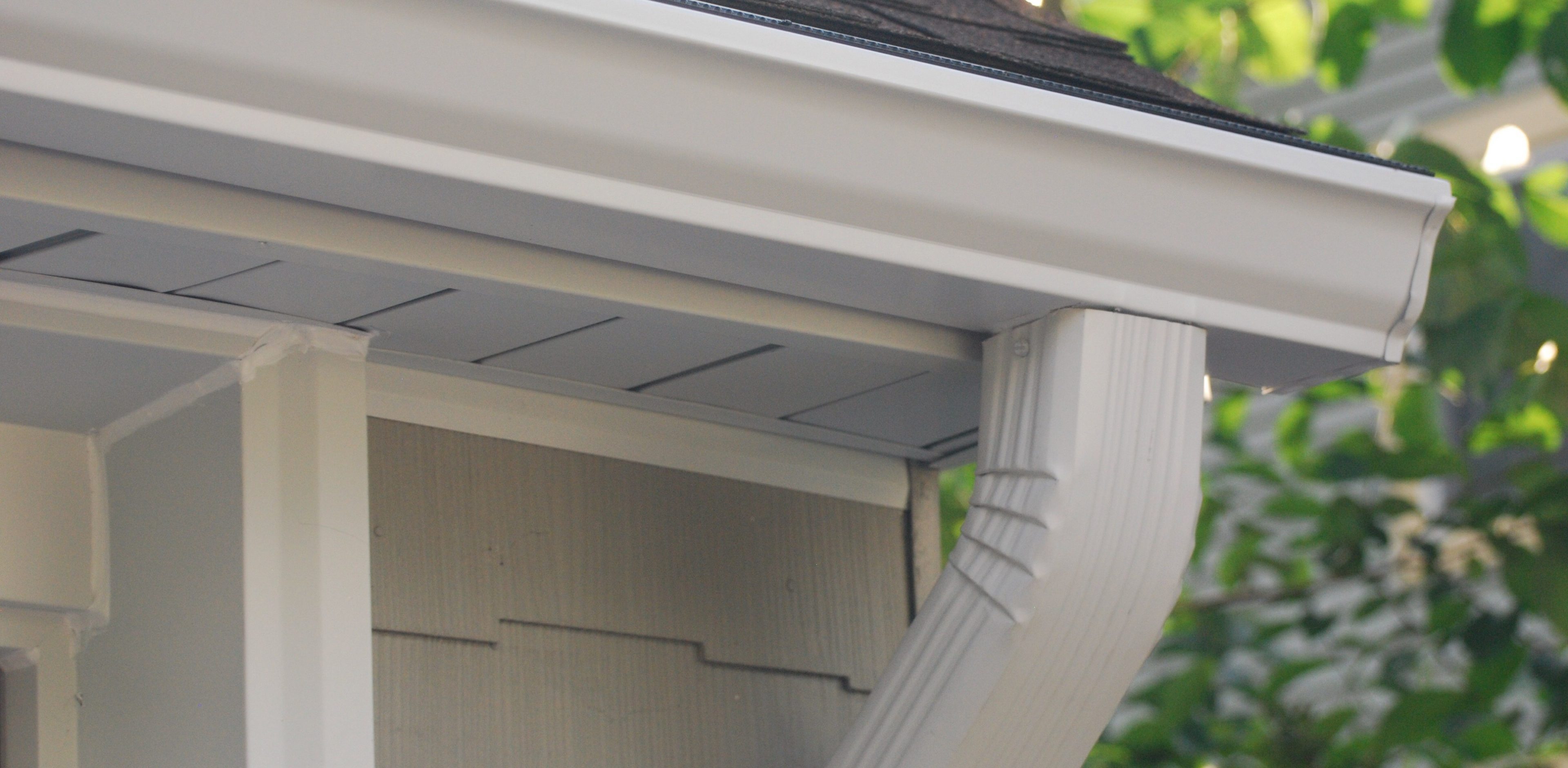
Updated October 2026. We rewrote these gutter tips as a step-by-step job: clean, find leaks, reseal, refasten, fix downspouts, and know when to replace. Lifespans are from InterNACHI’s chart, read this month.
To fix gutters, clean them out first, then reseal leaking seams, refasten sagging sections with hidden hangers or gutter screws, and make sure each downspout sends water at least a few feet from the house. As of October 2026, InterNACHI puts aluminum gutters at 20 to 40+ years and galvanized steel at about 20, so rust often means it’s time to replace.
Jump to: 🪜 Cleaning · 🏠 Leaks · ⏱️ Sagging · 💲 Replace or repair · ❓ FAQ
Key takeaways
- Clean gutters at least twice a year, in late spring and after the leaves drop in fall. More often under pine or oak trees.
- Most leaks come from seams and end caps. A tube of gutter sealant fixes them for a few dollars.
- Old spikes work loose over time. Gutter screws with ferrules, or hidden hangers, hold much better.
- Water damage and freezing made up 22.6% of homeowners insurance losses in 2023 (Triple-I). Gutters are your first line of defense.
Gutters are boring until they fail. Then you get a wet basement, rotted fascia boards, peeling paint or a trench along the foundation. The good news: most gutter jobs are a Saturday with a ladder, a bucket and a few hardware store parts.
A word on safety before anything else. Use a sturdy extension ladder on firm, level ground, keep three points of contact, and don’t lean out past the rails. Have someone hold the ladder. If your roofline is two stories or steep, hire it out; the savings aren’t worth a fall.
What tools do you need for gutter work?
You don’t need much, and most of it you may already own. Here’s a short list for a one-story house:
- An extension ladder with a stand-off bracket, so it rests on the roof and not on the gutter.
- Work gloves, safety glasses and a small bucket with a hook.
- A gutter scoop or a plastic trowel, plus a garden hose with a spray nozzle.
- Gutter sealant, a putty knife and a wire brush.
- Gutter screws, ferrules or hidden hangers, and a drill with a hex bit.
- A pop rivet tool and rivets for downspouts.
Buy fasteners that match your gutter metal. Mixing steel screws with aluminum gutters can cause corrosion where they touch.
How do you clean gutters properly?
- Start at the downspout end. Scoop out leaves and sludge with a gutter scoop or a gloved hand into a bucket hooked to the ladder.
- Bag the debris or compost it. Rotted leaves make good mulch.
- Flush the gutter with a garden hose, working toward the downspout. Watch where the water slows; that’s a low spot or a clog.
- Clear the downspout. If water backs up, push a plumber’s snake up from the bottom, or blast it with the hose from the top.
- Check that water exits freely at the bottom.
Some people use a pressure washer to clean the gutter channel. That works if the gutters are firmly attached. Keep the spray low and pointed along the gutter, not up toward the roof, or you can lift shingles and force water under them.
Guards and screens cut down on cleaning, but they don’t end it. Fine debris and pine needles still build up on top, and you’ll need to lift and clean them every year or two.
How do you find and seal gutter leaks?
Run the hose into a clean gutter and walk underneath. Drips usually show up at three spots: corner seams, end caps and around the downspout outlet. Small holes in the gutter body come next, especially on older steel gutters.
- Scrape out old, cracked caulk with a putty knife or an old chisel.
- Clean the area with a wire brush and let it dry completely.
- Apply a bead of gutter sealant (a silicone or butyl product rated for gutters) on the inside of the seam.
- For a hole, cover it with a patch of matching metal flashing set in sealant.
- Check downspout rivets while you’re up there. Replace loose or missing ones with a pop rivet tool, which costs around $20 at most hardware stores.
Sealing from the inside matters. Water should run over the sealant, not push against its edge.
How do you fix sagging gutters?
Sagging usually means the fasteners have pulled out of the fascia board. On older homes, that’s often the long spike-and-ferrule system: a spike goes through the gutter, through a tube (the ferrule) and into the fascia. Over years, heat, cold and weight push the spikes back out. Sometimes they never hit the rafter tail behind the fascia at all.
The fix is to swap spikes for screws, one at a time:
- Pull one old spike with a pry bar or pliers.
- Set a new ferrule in the gutter behind the old hole.
- Drive a gutter screw through the hole and ferrule into the fascia, slowly, with a variable-speed drill.
- Stop when the head sits snug against the gutter lip.
- Move to the next spike. Replacing them one by one keeps the gutter supported.
Hidden hangers are another option. They clip inside the front lip and screw into the fascia, out of sight. Space them about every two feet, closer in snowy areas.
If the fascia board itself is soft or rotted, the screws won’t hold. Replace that section of board first. It’s a sign that water has been getting behind the gutter for a while.
Sell smarter
List your home on the MLS from $99
A flat fee instead of a percentage, and $0 to Beycome at closing. You stay in control of your sale.
Sell your home →Buy smarter
Get up to 2% back at closing
On homes listed by other agents, Beycome credits you up to 2% of the price at closing (1% kept, $1,499 minimum; not on FSBO homes or homes listed by Beycome sellers).
Buy a home →Check the slope while you’re at it. Gutters should fall slightly toward each downspout, roughly a quarter inch per 10 feet. A level and a string line will show you any flat or backward sections.
Where should downspout water go?
Away from the house. A downspout that dumps water right at the foundation undoes everything else. Add an extension or a splash block so water lands several feet out, on ground that slopes away.
Rain barrels are another option. The EPA’s Soak Up the Rain program notes that rain barrels capture roof water for later use on lawns and gardens and reduce runoff from your property. The EPA also points out that roof water can pick up bacteria and chemicals, so think twice before using it on edible plants.
Should you repair or replace your gutters?
Use age, material and damage to decide. Here’s what InterNACHI’s life expectancy chart lists for common gutter materials:
| Material | Typical life (InterNACHI) | Signs it’s time to replace |
|---|---|---|
| Galvanized steel | About 20 years | Rust holes, flaking, many patches |
| Vinyl | 25+ years | Cracks, brittleness, warped sections |
| Aluminum | 20 to 40+ years | Many leaking seams, dents, pulled-away runs |
| Copper | 50+ years | Rarely; usually seam or bracket repairs |
If old steel gutters are only lightly rusted, you can wire-brush the rust, prime with a rust-inhibiting primer and paint. Once rust has eaten through in several places, new gutters are the better spend. One-piece aluminum runs, formed on site from a coil, have far fewer joints to leak.
For video walk-throughs and project ideas, DIY Network (www.diynetwork.com) has step-by-step home repair content. And if gutter damage has spread to the roof edge, see our tips on making a roof last longer.
Do gutters matter when you sell your house?
Yes, more than people expect. Home inspectors check gutters and downspouts, and they look for what bad drainage leaves behind: stained siding, rotted fascia, damp basements and soil washing away at the foundation. Fixing gutters before you list is a cheap way to avoid a longer repair list later.
Gutters show up on most pre-sale repair lists for that reason. Our guides on repairs to consider before selling, important house repairs and fixes to complete before listing put them in context. For bigger outside projects, see how exterior renovations can increase property value, or start with simple maintenance strategies.
When the house is ready, you can list it yourself through Beycome from $99, with $0 due to Beycome at closing. Your home goes to the major home search sites and the MLS, and you keep every decision. See the flat fee MLS packages.
Gutter repair questions
How often should gutters be cleaned?
At least twice a year, in late spring and late fall. Homes under heavy tree cover may need it three or four times.
Why are my gutters overflowing?
Usually a clog in the gutter or downspout. It can also mean the slope is wrong or the gutter is too small for the roof.
How do I fix a leaking gutter seam?
Scrape out old caulk, clean and dry the seam, then apply gutter sealant on the inside. Let it cure before the next rain.
How long do gutters last?
InterNACHI lists about 20 years for galvanized steel, 25+ for vinyl, 20 to 40+ for aluminum and 50+ for copper.
Can I fix sagging gutters myself?
Yes, on a one-story home. Replace loose spikes with gutter screws or hidden hangers. Repair any rotted fascia first.
Lifespans are InterNACHI estimates and vary with climate and maintenance. Hardware prices are approximate. Beycome prices as of October 2026: Basic $99; “$0 at closing” means no Beycome fee at closing; taxes, title and any buyer-agent compensation you agree to still apply. General information, not professional construction advice.
Sources
- InterNACHI, Standard Estimated Life Expectancy Chart for Homes, read October 28, 2026.
- Triple-I, Facts + Statistics: Homeowners and renters insurance, read October 28, 2026.
- EPA, Soak Up the Rain: Rain Barrels, read October 28, 2026.
- Beycome, listing package features, October 2026.
Disclosure & Disclaimer
Beycome provides real estate services through affiliated licensed brokerages and has a commercial interest in the services and business models discussed on this blog. Content reflects Beycome’s perspective and may promote our services; it should not be treated as independent or neutral reporting.
Articles are provided for general informational and educational purposes only, not as financial, tax, legal, or investment advice or a recommendation for your particular situation. Reading this blog does not create a brokerage, advisory, or other professional relationship.
Information, opinions, pricing, service descriptions, and comparisons reflect the sources and information available when an article was published or last updated and may change. Although we aim for accuracy, we do not guarantee that all content is complete, current, or applicable to your circumstances. Laws, market conditions, and service availability vary by location. Examples and estimated savings are illustrative, depend on stated assumptions, and do not guarantee individual results.
Verify relevant information directly and consult qualified professionals before making decisions. Beycome services are subject to applicable agreements, eligibility requirements, and state-specific terms.

