
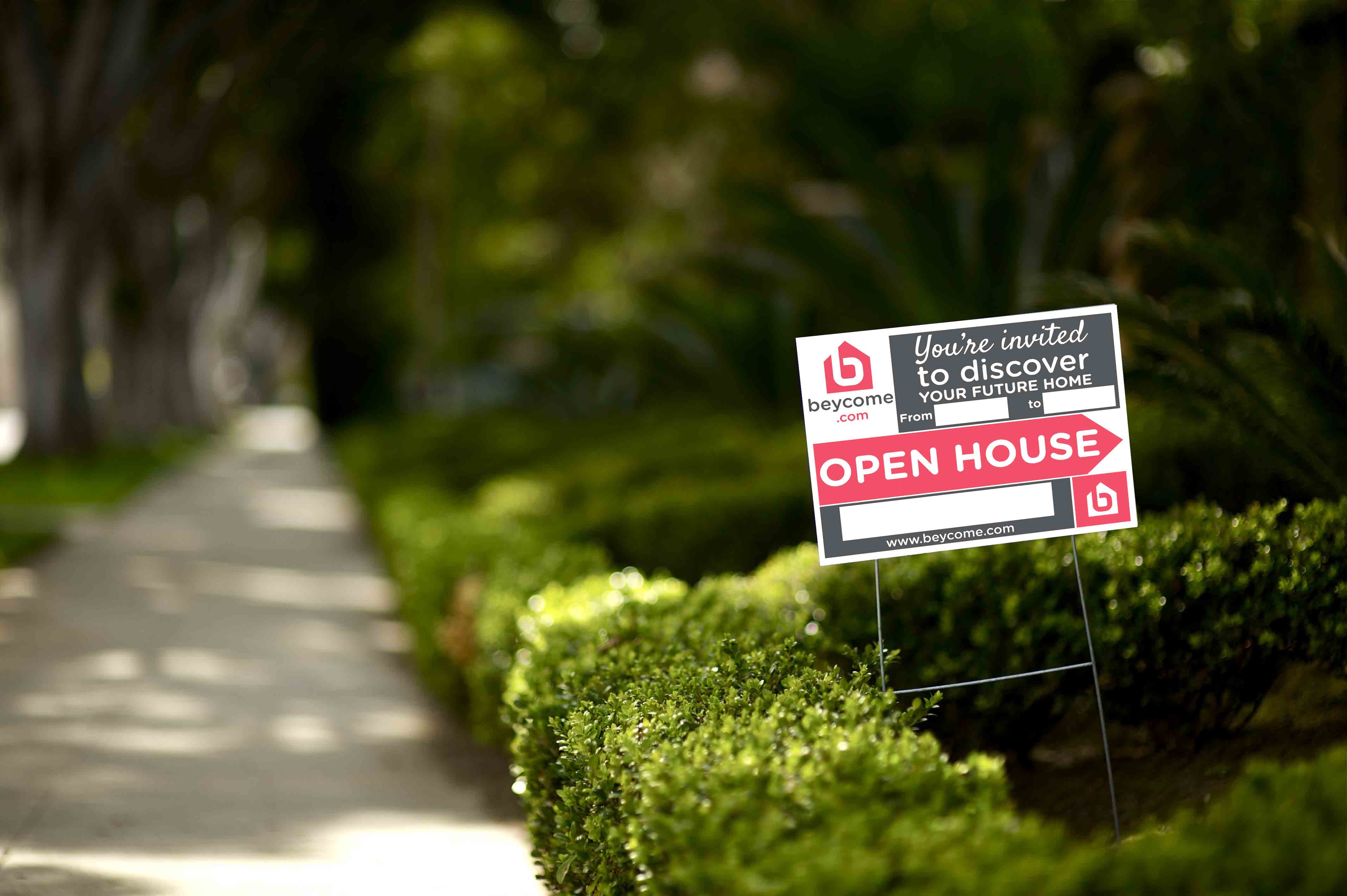
Updated October 2026. For sellers planning an open house, with or without an agent. Buyer and agent figures are from NAR’s 2025 Profile of Home Buyers and Sellers; package details are from Beycome’s plan page.
An open house signage kit is a yard sign for your lawn plus arrow signs that lead drivers from the main road to your door. As of October 2026, Beycome’s Enhanced plan ($399) includes one personalized yard sign and one open house signage package. NAR’s 2025 data shows 48% of buyers used open houses and 32% used yard signs in their search.
Jump to: 🏠 What’s in a kit · 🪜 How many signs · 📍 Where to place them · 💲 Beycome signs · ❓ FAQ
Key takeaways
- 48% of 2025 buyers used open houses in their search, and 32% used yard signs (NAR).
- Agents posted yard signs for 67% of their listings and held open houses for 59% (NAR, 2025).
- Count one arrow per turn from the nearest busy road, plus one at your curb.
- Beycome Enhanced ($399) includes one personalized yard sign and one open house signage package.
An open house only works if people find it. Your listing tells buyers when; your signs tell drivers where. Here’s what a good kit holds, how many signs you need and where they’re allowed to go.
Do open house signs still matter in 2026?
Yes, though they work alongside your online listing, not instead of it. In NAR’s 2025 Profile of Home Buyers and Sellers, 48% of buyers said they used open houses during their search and 32% used yard signs. Online tools came first: 70% searched on a phone or tablet.
Agents still lean on both. The same report found agents put up yard signs for 67% of the homes they listed and held open houses for 59%. Listing on the MLS came first, at 85%. So a sign doesn’t replace the MLS, but it catches neighbors and people driving by who already like the area.
Signs also help the buyers who saw your listing online. Arrows save them from missing a turn in a new neighborhood. Fewer lost visitors means more people through the door in a two-hour window.
What should an open house signage kit include?
Keep it simple. A kit that works has these pieces:
- A yard sign at the curb with “Open House,” the day and time, and a phone number or website.
- Directional arrow signs for each turn from the main road, each with a big, clear arrow.
- Sturdy stakes or A-frames so the signs stand up in wind.
- A sign rider or QR code that opens your listing page, so drive-by buyers can see the price and photos.
- Balloons or a small flag at the house, if your HOA allows them.
Stylish banners and custom colors can look good, but legibility wins. Use dark text on a light background and as few words as you can. A driver has a second or two to read an arrow.
Want a QR code on your sign? Our guide to for sale by owner signs with a QR code shows how it works, and what a FSBO sign should say covers the wording.
Should you buy a kit or make your own signs?
Either can work. A printed kit looks clean, matches your listing and holds up for many weekends. Hand-made signs cost less, but marker on poster board fades, curls in the rain and is hard to read from a car.
If you make your own, use corrugated plastic, not paper. Print the words with a large, bold font, and use one color for every sign so buyers learn to follow it. Test each sign from across the street before the day.
Whichever you pick, store the set flat and dry between open houses. If you hold more than one open house, the same kit gets used again. Note which spots worked, and use them again next time.
How many open house signs do you need?
Count the turns. Start at the nearest busy road a buyer would use and drive to your door. Each turn gets an arrow, plus one at your curb and the yard sign itself. A home one turn off a main road may need three signs. A home deep in a subdivision may need six or more.
Add one more arrow for each extra direction buyers might come from. If two main roads feed your street, cover both. Drive the route before the open house and fix any spot where you hesitated.
Open house arrows: small details that help
Put the arrow on the side of the road the driver is on, before the turn, not at it. Turn arrows on reflective board are easier to see in the late afternoon. Write the end time on the yard sign so late arrivals know if they still have time.
Sell smarter
List your home on the MLS from $99
A flat fee instead of a percentage, and $0 to Beycome at closing. You stay in control of your sale.
Sell your home →Buy smarter
Get up to 2% back at closing
On homes listed by other agents, Beycome credits you up to 2% of the price at closing (1% kept, $1,499 minimum; not on FSBO homes or homes listed by Beycome sellers).
Buy a home →Where can you place open house signs?
Rules are local, so check before you stake anything. Many cities limit signs in the public right-of-way, such as medians, sidewalks and utility poles. Some allow temporary open house signs only on open house days. HOAs often have their own rules on size and where signs can go.
- Ask your city or county code office about temporary real estate signs.
- Read your HOA rules, and ask the HOA manager if you’re not sure.
- Get a neighbor’s OK before you put an arrow on their lawn.
- Never block a sidewalk, a driveway or a driver’s view at a corner.
Put signs up an hour before you open and take every one down the same day. Leftover signs are the most common reason neighbors complain, and they can cost you a fine in some towns.
How do you plan an open house that people find?
Signs work best when the open house is already on your listing. Add the date and time to your listing first, so it shows on beycome.com and the sites that pull from the MLS. Beycome’s help page on how to add an open house shows the steps.
Then pick the time. Weekends draw the most visitors for most homes; our guides on scheduling your open house and the Sunday open house help you choose. For the day itself, read our open house tips: lights on, pets out, and a sign-in sheet at the door.
Good photos bring the people who follow your signs. If your listing photos are dark, see how to upgrade your listing photos before the weekend.
What signs come with a Beycome listing?
The Enhanced plan ($399) includes one personalized yard sign and one open house signage package, along with 25 professional HD photos, a photo session, flyers and a featured spot on beycome.com. That’s the “Beycome yard sign” many sellers ask about. The Basic plan ($99) puts your home on the MLS, and you can use your own signs.
Both plans include e-signature, unlimited listing updates, ShowingTime where available and the Artur AI assistant, with $0 due to Beycome at closing. Compare them on the flat fee MLS plans page.
After the open house comes the offer, then the closing. In Florida and Texas, Beycome title services can close your sale for a $99 settlement fee in Florida and $299 in Texas and in Michigan, Ohio, Illinois and Indiana.
Open house sign questions
How many open house signs do I need?
One arrow for each turn from the nearest busy road, one at the curb and your yard sign. That’s often three to six signs.
Where should I place open house signs?
Before each turn, on the driver’s side of the road, where local and HOA rules allow. Ask before using a neighbor’s lawn.
Does Beycome give you a yard sign?
Yes, on the Enhanced plan ($399): one personalized yard sign and one open house signage package. Basic sellers use their own.
Do buyers still use yard signs?
Some do. NAR’s 2025 Profile found 32% of buyers used yard signs and 48% used open houses during their search.
What should an open house sign say?
“Open House,” the day and hours, an arrow, and a phone number or web address. Fewer words read faster.
When should I put out open house signs?
About an hour before you open, and take them all down the same day.
Buyer and agent figures are from NAR’s 2025 Profile of Home Buyers and Sellers. Plan contents and prices as of October 2026 and subject to change; “$0 at closing” means no Beycome fee at closing, while other closing costs still apply. Sign rules vary by city, county and HOA; check before you place signs.
Beycome Title: Florida, Texas, Michigan, Ohio, Illinois and Indiana. General information, not legal advice.
Sources
Disclosure & Disclaimer
Beycome provides real estate services through affiliated licensed brokerages and has a commercial interest in the services and business models discussed on this blog. Content reflects Beycome’s perspective and may promote our services; it should not be treated as independent or neutral reporting.
Articles are provided for general informational and educational purposes only, not as financial, tax, legal, or investment advice or a recommendation for your particular situation. Reading this blog does not create a brokerage, advisory, or other professional relationship.
Information, opinions, pricing, service descriptions, and comparisons reflect the sources and information available when an article was published or last updated and may change. Although we aim for accuracy, we do not guarantee that all content is complete, current, or applicable to your circumstances. Laws, market conditions, and service availability vary by location. Examples and estimated savings are illustrative, depend on stated assumptions, and do not guarantee individual results.
Verify relevant information directly and consult qualified professionals before making decisions. Beycome services are subject to applicable agreements, eligibility requirements, and state-specific terms.

