
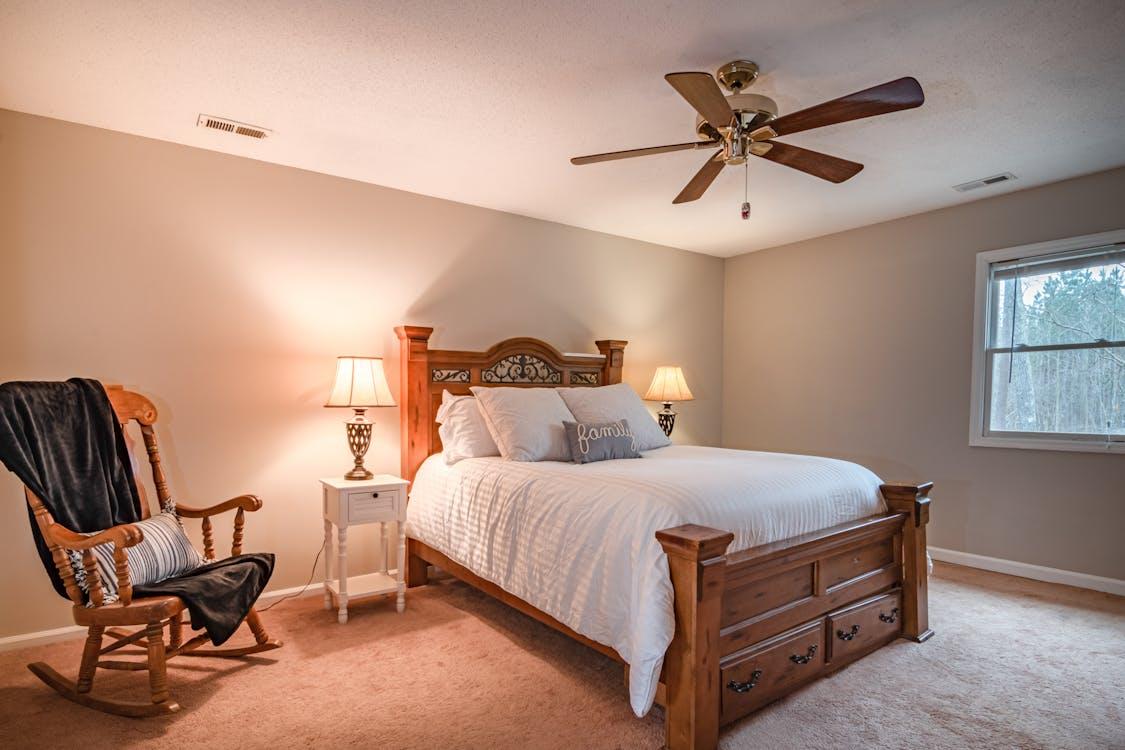
Updated October 2026. How to pick, place and style ceiling fans, with sizing numbers from a fan maker, efficiency figures from ENERGY STAR, and what a fan does for your listing photos if you plan to sell.
The right ceiling fan fits the room’s size first and its style second. As of October 2026, Hunter’s guide matches rooms up to 100 square feet with 30- to 48-inch fans, rooms up to 400 square feet with 48 to 54 inches, and larger rooms with 56 inches or more. ENERGY STAR certified fans are up to 44% more efficient than conventional ones.
Jump to: 📸 Size and height · 🏠 Style · 💲 Lights and efficiency · 🤝 Before you sell · ❓ FAQ
Key takeaways
- Size by square footage: up to 100 sq ft, 30 to 48 inches; up to 400 sq ft, 48 to 54 inches; over 400 sq ft, 56 inches or more (Hunter).
- Match the mount to the ceiling: flush mount around 8 feet, standard around 9 feet, and a downrod on higher ceilings so the fan hangs 8 to 9 feet up (Hunter).
- ENERGY STAR certified ceiling fans are up to 44% more efficient than conventional fans.
- Hunter says a fan can make a room feel 6 to 8 degrees cooler in summer, which lets the air conditioner work less.
Ceiling fans are fixtures you look at every day, so they can tie a room together or pull it apart. Pick one that suits your household furniture, your flooring and the way you use the room. And if you might sell in the next few years, a fan is one of the cheaper updates buyers notice in photos.
What size ceiling fan does each room need?
Air movement depends mostly on the fan’s diameter, or blade span. Measure the room’s length and width and multiply to get square feet. Then use the ranges from Hunter’s sizing guide, read October 27, 2026:
| Room size | Blade span | Typical rooms |
|---|---|---|
| Up to 100 sq ft | 30 to 48 inches | Home office, laundry room |
| Up to 400 sq ft | 48 to 54 inches | Bedroom, living room, kitchen |
| Over 400 sq ft | 56 inches or more | Open-plan living, lofts |
In a long room or an open plan, two fans often work better than one huge one. Space them so each covers its own zone, such as the sitting area and the dining table. Right over the table, a chandelier usually does the job better; see what size chandelier a dining room needs.
How high should the fan hang?
Match the mount to the ceiling. Hunter recommends flush-mount, low-profile fans for ceilings around 8 feet, standard mounts for ceilings around 9 feet, and a downrod on higher ceilings so the fan hangs 8 to 9 feet from the floor. On vaulted ceilings, use the angled mount the fan is rated for. Keep the blades clear of walls, cabinets and light fixtures.
Outdoors and in bathrooms, check the rating. Hunter describes damp-rated fans for covered porches and humid rooms, and wet-rated fans for spots exposed to rain, like a pergola.
How do you choose a ceiling fan that fits your style?
Start with the room’s main finishes. Modern rooms suit clean lines, metal finishes and solid colors. Farmhouse and country rooms suit wood blades, bronze or a distressed finish. Industrial lofts can carry exposed metal and simple shapes, while a coastal room looks right with light woods, white and woven details.
Should the fan match the room’s colors?
You can blend in or stand out. White, black and brushed nickel blend with almost anything. A wood fan that echoes your floors or furniture ties a room together. If you’d like a focal point, pick an accent finish that contrasts with the walls, and repeat it once elsewhere, such as in a lamp base or frame.
Small touches finish the look. A decorative pull chain, a ceiling medallion or a better glass shade can make an older fan feel new for little money.
Should you get a ceiling fan with a light?
In bedrooms and living rooms without other overhead lighting, a fan with a light kit can be the main light. LED kits use less power and last longer. A dimmer, or a fan with a remote, lets you go from bright for cleaning to soft for the evening.
If the room already has recessed lights, a fan without a light keeps the ceiling cleaner. Either way, pick a color temperature that matches the rest of the room, so one fixture doesn’t look blue next to warm lamps.
Do efficient fans save money?
Yes, a little on the fan and more on cooling. ENERGY STAR says certified ceiling fans are up to 44% more efficient than conventional fans, thanks to better motors and blades. Hunter notes a fan can make a room feel 6 to 8 degrees cooler in summer, so the air conditioner works less. In winter, Hunter suggests running the fan clockwise on low to push warm air down without a draft.
Fans work with your heating and cooling, not instead of them. For more on keeping your system efficient and the comfort of your home steady year-round, an HVAC-focused guide is a good next read.
Sell smarter
List your home on the MLS from $99
A flat fee instead of a percentage, and $0 to Beycome at closing. You stay in control of your sale.
Sell your home →Buy smarter
Get up to 2% back at closing
On homes listed by other agents, Beycome credits you up to 2% of the price at closing (1% kept, $1,499 minimum; not on FSBO homes or homes listed by Beycome sellers).
Buy a home →What features matter most in daily use?
Look for these before you buy:
- Several speeds and a reverse function, so the fan works in summer and winter.
- A quiet motor, which matters most in bedrooms.
- A remote or wall control if the ceiling is high or the pull chain is out of reach.
- Smart controls if you already run a smart home system.
- Balanced blades and a solid mount, so the fan doesn’t wobble.
To browse current styles and sizes in one place, see these ceiling fans from a long-running US fan maker.
Should you replace ceiling fans before you sell your home?
Often, yes, if they’re dated, noisy or wobbly. Fans sit at the top of almost every listing photo, so a yellowed 1990s fan dates the whole room. Replacing a few with simple modern ones costs far less than a renovation, and it fits the same thinking as staging a house to sell.
Keep it simple: neutral finishes, matching fans in connected rooms, and working lights. Turn the fans off for photos so the blades don’t blur. If you’re doing a wider refresh, our home staging tips and guide to making a house more attractive to buyers help you pick what’s worth the money. For empty rooms, virtual staging can show buyers how the space works.
When you’re ready, Beycome lets you list your home on the MLS for a flat fee: Basic $99 or Enhanced $399 with 25 professional photos, and $0 to Beycome at closing. Beycome lists in 17 states and DC. Start with an estimate of what your home is worth.
Buying a home instead? The Beycome buyer program has no upfront fee. Beycome keeps 1% of the price (minimum $1,499) and credits the rest of the buyer-agent commission at closing, with lender approval. It’s open to every buyer on homes listed by other agents; the commission credit can’t apply where no buyer-agent commission is offered, like most FSBO homes, or on homes listed by Beycome sellers.
Frequently asked questions about ceiling fans
What size ceiling fan do I need for a 12 by 12 bedroom?
That’s 144 square feet, which falls in Hunter’s up-to-400 square feet range: a 48- to 54-inch fan.
Which way should a ceiling fan spin in winter?
Hunter suggests clockwise on low speed, which pushes warm air down without a cooling breeze.
Can I put a ceiling fan on a low ceiling?
Yes. Hunter recommends a flush-mount, low-profile fan for ceilings around 8 feet.
Are ENERGY STAR ceiling fans worth it?
ENERGY STAR says certified fans are up to 44% more efficient than conventional ones, so they cost less to run over the years.
Can I use an indoor ceiling fan on a covered porch?
Use a damp-rated fan for covered porches and a wet-rated fan where rain can reach it, per Hunter’s guidance.
Do ceiling fans help sell a house?
Updated, quiet fans make rooms look current in photos and showings. They’re a small cost next to a remodel.
Sizing, mounting, outdoor ratings and the 6 to 8 degree figure come from Hunter’s ceiling fan guide; efficiency from ENERGY STAR. Both read October 27, 2026. Manufacturer guidance varies by model; follow the instructions for your fan, and use a licensed electrician where wiring or a fan-rated box is needed.
Beycome prices as of October 2026. “$0 at closing” means no Beycome fee at closing; other closing costs still apply. Listing term: the maximum the state and MLS allow (24 months; 12 in MD and PA). Buyer credit: minimum $1,499, lender approval, not on FSBO homes or homes listed by Beycome sellers.
Sources
- Hunter Fan, How to Choose a Ceiling Fan Size & Style, read October 27, 2026.
- ENERGY STAR, Ceiling Fans, read October 27, 2026.
- Beycome, listing package features, October 2026.
Disclosure & Disclaimer
Beycome provides real estate services through affiliated licensed brokerages and has a commercial interest in the services and business models discussed on this blog. Content reflects Beycome’s perspective and may promote our services; it should not be treated as independent or neutral reporting.
Articles are provided for general informational and educational purposes only, not as financial, tax, legal, or investment advice or a recommendation for your particular situation. Reading this blog does not create a brokerage, advisory, or other professional relationship.
Information, opinions, pricing, service descriptions, and comparisons reflect the sources and information available when an article was published or last updated and may change. Although we aim for accuracy, we do not guarantee that all content is complete, current, or applicable to your circumstances. Laws, market conditions, and service availability vary by location. Examples and estimated savings are illustrative, depend on stated assumptions, and do not guarantee individual results.
Verify relevant information directly and consult qualified professionals before making decisions. Beycome services are subject to applicable agreements, eligibility requirements, and state-specific terms.

