Skip to content Skip to main navigation Skip to footer

knowledge-base/

How to add your property on facebook marketplace

Exposure, exposure, exposure!

When it comes to selling your home, visibility is everything. Learning how to add your property on Facebook Marketplace can greatly enhance your listing’s exposure. The more eyes on your property, the more chances you have to attract serious buyers—and the faster you can close. So, understanding how to add your property on Facebook Marketplace is crucial.

That’s why Beycome, with purchasing our Flat Fee MLS packages, automatically lists your property on all major real estate platforms: Zillow, Realtor.com, Trulia, MLS, and hundreds more. But we don’t stop there.

We strongly encourage you to share your listing on Facebook Marketplace, one of the most visited platforms by active home seekers. Learning how to add your property on Facebook Marketplace is free and incredibly powerful—especially when combined with your listing on traditional real estate websites.

To help you do this in under 2 minutes, check out the video below and follow the simple steps on how to add your property on Facebook Marketplace.

Watch how to post on Facebook Marketplace →

Every additional platform is another opportunity to connect with the right buyer. Don’t underestimate the power of broad exposure—it could be the key to your sale.

Discover How to Create a Craigslist Property Listing

How to add a documents on your dashboard

Managing your paperwork is an important part of your real estate transaction, and Beycome gives you full control. Whether you need to update your closing date, learn how to add a document on your dashboard for review, or simply stay organized, everything starts in your profile.

When you connect to your Beycome dashboard, you’ll find a dedicated area for managing documents tied to your property. This makes it easy to upload agreements, add disclosures, and share updates with the buyer or title company. It also helps keep your file complete without email chains or messy paperwork. Having your documents in one place ensures your transaction moves smoothly. It also gives everyone access to what they need, when they need it.

If you ever need to change your closing date or add a new document, the process is simple. Log into your profile, navigate to your property, and upload the necessary form or proof so our team and the other party can review it. This keeps everything transparent and secure. It provides you real-time control over your deal.

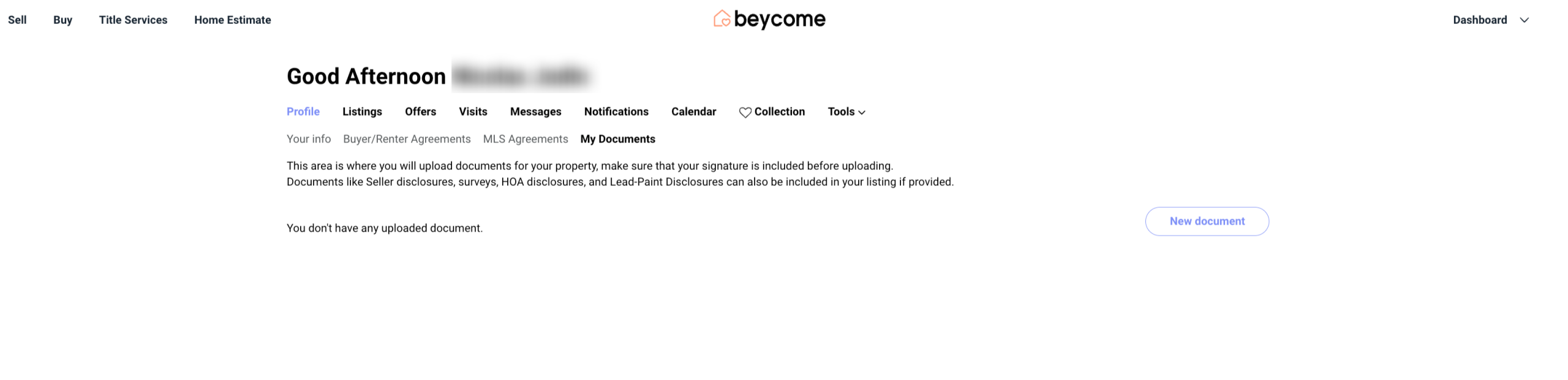
Connect to My Profile for guidance on how to modify your closing date on beycome.

On the menu select “My Documents”
In “New document” choose the property address of your property.
Select the ” Type of document” then  “Upload your document” Press “Upload” to validate.

That’s it. Once uploaded, the document becomes part of your transaction file and can be referenced whenever needed. Using your dashboard to manage closing changes and documents helps prevent delays and keeps your deal organized. It gives you a professional-level system without extra fees or complexity.

How to add a documents on your dashboard

Important:

Our service representative will update your property after receiving the information. Additionally, understanding how to add a documents on your dashboard will streamline this process. After we update on our end, our syndicated website partners and MLS require 1 to 2 business days to populate.

For security purposes, we need to be notified by you via your Beycome account only to adjust your listing with your modifications. Clearly knowing how to add a documents on your dashboard ensures these adjustments are accurate. We cannot accept any change requests by email or phone call.

Understanding North Carolina’s Square Footage Measurement Requirements

When listing a property in North Carolina, ensuring accurate square footage measurements is not just a best practice—it’s mandatory. One must adhere to North Carolina’s Square Footage Measurement Requirements. The North Carolina Real Estate Commission (NCREC) requires that all listed properties be measured in accordance with the Residential Square Footage Guidelines Manual.

A qualified professional from one of the following categories must take these measurements:

  • Professional Measuring Service (Recommended)
  • Actively Licensed North Carolina Real Estate Broker
  • Licensed Appraiser

Below, we’ll explain the specifics of these requirements, answer common questions, and provide examples of qualified providers by county.

1. Can I provide my own measurements?
No, North Carolina requires that a professional, such as a measuring service, licensed broker, or appraiser, measure the property to ensure compliance with NCREC guidelines.

2. Can I use an app to measure the property?
No, property measurements must be completed by a qualified professional. Apps and other DIY tools are not permitted.

3. Can I rely on a previous appraisal?

Unfortunately, no. You must take new measurements for the current transaction to meet state requirements.

4. Is it okay to use tax records for square footage?

No but you can review tax records for reference, but the state doesn’t consider them a reliable or accurate source.

5. What happens if the advertised square footage is incorrect?
If the square footage is wrong, buyers may pursue legal remedies such as damages or contract changes, according to NC Realtors.

6. Can unpermitted areas of the house be included in the total square footage?
No. You must list unpermitted areas separately, and you can’t include them in the property’s total square footage.

7. What about decks, porches, or garages?
You should not include decks, balconies, porches, garages, or carports in any category of finished or unfinished living area.


What’s Included in the Professional Measurements?

1. Heated Living Area / Living Area
To qualify as living area, the space must be:

  • Heated by a permanent heating system (e.g., forced air, radiant, solar). Portable heaters or fireplaces are not acceptable.
  • Suitable for year-round occupancy.
  • Directly accessible from other living areas through a door, heated hallway, or stairway.

2. Unheated Living Area
This includes spaces that contribute to the home’s value but do not meet the criteria for heated living areas. Examples:

  • Unheated sunrooms or porches.
  • Finished rooms that are unheated.
  • Unfinished attic spaces with permanent stairs.

3. Additional Square Feet

Spaces such as basements or areas without direct access to the main dwelling fall into this category. You should list these areas separately in the property description or include them in the agent remarks.


Why Accurate Measurements Matter

Accurate square footage is critical for protecting buyers, sellers, and agents from potential disputes.

Misrepresenting square footage, for example, can lead to serious legal consequences. As a result, you could face financial penalties or even contract reformation.


Recommended Measuring Services by County

We’ve compiled a list of measuring services by county to help you meet North Carolina’s requirements.

Although Beycome does not guarantee or endorse these companies, they serve as helpful examples and a solid starting point for finding qualified professionals in your area.

Accurate measurements are not just a legal requirement—they’re essential for building trust and transparency in the real estate process. When you hire a professional to measure your property, you create a smoother transaction and reduce the risk of costly errors.

list of measuring services

James Powell Appraisal JAMESPOWELL@ATMC.NET; billy.jpa@atmc.net 910-755-7070; 910-209-1288, Mark – 828-244-5836 $ 150.00
Appraise the Beach appraisethebeach@icloud.com 252-626-4104 $ 150.00
Raleigh, Durham, Franklin, Ganville, Johnston, Lee, Person, Wake, Nash Harmon Property Solutions matt@harmonps.com 919-606-1935 $ 125.00
Mc Namara
Forsyth, Davidson, Davie, Yadkin and southern Stokes Counties Triad Measuring Info@DavidsonPropertyServices.com 336-416-0236
Catawba Valley Appraisal jstewart.appraiser@gmail.com 828-612-6221 $ 75.00
Cornelius, Huntersville, Waxhaw, Matthews, Fort Mill, Pineville, Greensboro, Winston-Salem, High Point, Thomasville, Jamestown, Kernersville Steel Tape lisa@steeltapemeasuring.com; clay@steeltapemeasuring.com 336-442-7372
A Measure Up / Pacifico Property Services service@ameasureup.com services@pacificopropertyservices.com 980-616-2615 $ 75.00
Counties covered…Alexander, Alleghany, Ashe, Avery, Burke, Cabarrus, Caldwell, Catawba, Cleveland, Davidson, Davie, Forsyth, Gaston, Guilford, Iredell, Lancaster, SC, Lincoln, McDowell, Mecklenburg, Rowan, Stanly, Stokes, Surrey, Union, Watauga, Wilkes, Yadkin, York County, SC Carolina Measure Pro Don@CarolinaMeasurePro.com 336-355-7971 $ 135.00
Shindler Solutions 828-367-7133
Measure-Rite LLC a.zalys@hotmail.com 828-231-7305
Serving Henderson, South Buncombe, Polk & Transylvania Counties Cook Appraisals david@cookappraisalinc.com 828-551-9565
Home Dimensional homedimensional@gmail.com 910-352-4632 $ 125.00
Bullard Associates jpatrickbullard@gmail.com 910-638-5352
Cumberland, howe, Hornett & Monroe Counties. Market Value Appraisers marketvaluerealty@yahoo.com 910-916-9819 $75 – $175
Arsenal Appriasals orders@arsenalappraisal.com; info@arsenalappraisal.com 910-423-1861
Appalachian Appraisal Inc housercj1@gmail.com 706-994-3665
Howard Appraisal Service wbhoward@windstream.net; jwhowapp@outlook.com 706-745-0071
Whittarch Appraisals WhichardAppraisal@charter.net 252-538-0093
Triangle East Appraisals triappseast@cocentral.com 252-234-7575
Counties they cover: Onslow Craven, Carteret , Pamlico, Pender, New Hanover, Jones County Maready Appraisals info@mareadyappraisals.com 910.326.6511
Moore, Lee, Harnett, Richmond, Hoke, Cumberland, Scotland, Robeson, Randolph, Chatham, Anson & Montgomery counties (Pinehurst) Village Appraisers (910) 215-5866
Matthews Appraisals mathewsappraisal@gmail.com (910) 315-9440
JWH Appraisals value@jwhappraisal.com 910-377-1515


Disclaimer:The information provided, including company listings and pricing details, is for informational purposes only. Therefore, users should verify all details before making any decisions or financial commitments. 

Beycome has no financial affiliation, endorsement, or partnership with any of these companies and does not guarantee their services or pricing. We encourage all users to verify details independently and choose providers at their own discretion.

What Happens After Your Property Goes Under Contract

Venturing into the realm of property selling as a homeowner can be an exhilarating endeavor, fraught with uncertainties and endless inquiries. After all, it’s not merely a financial transaction; it’s the gateway to your future life phase. However, breathe easy, because you’ve chosen to navigate this journey with Beycome 😉

Let’s start:

First, let’s clarify what ‘under contract’ denotes. A house enters ‘under contract’ status when both parties – the buyer and the seller – mutually agree on the price and conditions, followed by the signing of a purchase agreement. Once this step is completed, the property is labeled as a ‘pending sale’. However, there remain several crucial steps to be executed before the deal can be officially sealed, marking the transition of your home ownership.

Before the sale is finalized, all contingencies in the contract must be met. In the world of real estate, the term ‘contingencies’ refers to specific conditions outlined in the contract. These must be satisfied before a property sale can be finalized. Often, these contingencies involve factors. These factors could influence the buyer’s decision to complete the purchase. Let’s take a closer look at the four most common contingencies you might encounter after the buyer deposits earnest money into escrow:

Financing Contingency:

The financing contingency is a common clause you’ll see when the buyer is planning to secure a mortgage to purchase your property. Although they’ve likely already shared their mortgage approval letter and have been pre-approved by the lender, the actual financing isn’t officially guaranteed yet. This contingency essentially states that the deal hinges on the buyer securing the necessary financing.

The Role of Appraisal Contingency:

This contingency exists primarily to protect the interests of the lender. An appraiser assesses your property to confirm that its market value is in line with the loan amount the buyer is requesting. If the property appraises for less than the agreed-upon price, this can pave the way for negotiations, or in some cases, even lead to the buyer backing out of the deal.

Inspection Contingency:

Almost all buyers opt for a thorough home inspection before finalizing the purchase. The inspection contingency allows the buyer the leeway to negotiate repairs, or, in cases where the inspection unveils significant issues, to walk away from the deal entirely.

Home Sale Contingency:

Often, buyers are juggling the sale of their own property while purchasing yours. A home sale contingency provides assurance that the buyer’s commitment to buy your house is contingent upon the successful sale of their own property.
While the financing, appraisal, and inspection contingencies are fairly standard inclusions in most real estate contracts, the home sale contingency isn’t as typical but certainly isn’t uncommon. As you navigate the closing process, understanding these contingencies will help ensure a smooth and successful transaction.

What Actions Remain Before the Transaction Can Be Finalized

Home Inspection and Repairs:

Typically, the first thing that happens after a home goes under contract is the buyer schedules a home inspection. This usually takes place within 7-10 days of signing the contract. The purpose of the inspection is to identify any potential issues or defects that may need to be addressed.
If significant problems are discovered, the buyer may ask for repairs to be made, a reduction in price, or even, in some cases, decide to back out of the contract. This negotiation process can sometimes be stressful, but remember, it’s all part of ensuring a fair transaction for both parties.

Appraisal:

After the inspection process, an appraisal is conducted by a neutral third party (usually hired by the buyer’s lender) to determine the fair market value of your home. The appraisal protects the lender by ensuring that the loan amount is not more than what the property is worth.
If the home appraises at or above the agreed-upon sale price, the process will proceed smoothly. However, if the appraisal is lower than the sale price, the buyer may need to come up with the difference, negotiate a lower price, or walk away from the sale if an agreement can’t be reached.

Final Mortgage Approval:

Assuming the buyer is borrowing money to purchase your home, they will be working diligently behind the scenes to obtain final mortgage approval. This involves providing their lender with all necessary documentation to confirm their ability to repay the loan. Any hiccups in this stage can delay the closing process or potentially nullify the contract.

Title Search and Insurance:

A title company will conduct a thorough search to ensure that the property is free from any legal issues, liens, or claims that might affect the sale. They will also arrange for title insurance, which protects the buyer (and their lender) from any potential future disputes regarding property ownership. beycome Title is offering his services for $199 flat fee. See more 

Final Walkthrough:

Usually conducted a few days before closing, the final walkthrough is the buyer’s chance to ensure that the property is in the agreed-upon condition and that any requested repairs have been made.

Utility Arrangements

Several days before the closing of your home, it’s important to arrange for the discontinuation of all your utilities. Services such as gas, electricity, cable, water, telephone, and Internet should all be scheduled to be shut off immediately when you vacate the property.

Closing:

The last stage of the process is the closing, where all parties meet to finalize the transaction. During this meeting, all documents are signed, and funds are transferred. As a seller, this is where you’ll hand over the keys and say goodbye to your old home. It;’s also the time that you contact beycome, and provide them with your executed closing statement or ALTA, to finalize the sale an update the title in the MLS system.
In summary, while going ‘under contract’ is a crucial step towards selling your home, it’s essential to understand that this doesn’t mean the sale is complete. Patience, open communication, and preparedness for negotiations will go a long way in ensuring a smooth journey from ‘under contract’ to ‘sold’.

How to reactivate your listing

Connect to My Dashboard

On the menu “Status” select “Publish”
Press “Confirm” to validate this change.

Our service representative updates your property’s status after receiving the information.  After we update on our end, our syndicated website partners and MLS require 1 to 2 business days to populate.

Please remember, for security purposes, we will need to be notified by you via your beycome account only to be able to adjust your listing with your modification. We can’t accept any change requests by email or phone call.

*This action is required if your home was listed on beycome.com, with or without purchasing our Flat Fee MLS packages.

How to modify closing date

  1. Connect to My Dashboard
  2. On the menu “Status” select “Under Contract”
  3. In “Expected closing date” update the new closing date based on your needs.
  4. Press “Confirm” to validate this change.

Our service representative updates your property’s status after receiving the information.  After we update on our end, our syndicated website partners and MLS require 1 to 2 business days to populate.

Please remember, for security purposes, we will need to be notified by you via your beycome account only to be able to adjust your listing with your modification. We can’t accept any change requests by email or phone call.

*This action is required if your home was listed on beycome.com, with or without purchasing our Flat Fee MLS packages.

Open House Schedule: How to cancel it

You can cancel an open house on your property from the beycome.com dashboard.

Here’s how:

  1. Connect to My Dashboard
  2. On the “Edit” menu select “Open House
  3. Select the Open house that you want to cancel and press ” Delete”
  4.  Confirm your action by clicking on the Confirmbutton.

Our service representative updates your property’s status after receiving the information.  Syndicated website partners and MLS require 1h to 2 business days to populate.
Please remember, for security purposes, we will need to be notified by you via your beycome account only to be able to adjust your listing with your modification. We can’t accept any change requests by email or phone call.

For a guide on how to share on social media and get your property more exposure click here

Can I Borrow an Earnest Money Deposit?

An earnest money deposit is first made when a buyer wants to show their interest while seeking additional financing. Traditionally, it totals 1-3% of a house’s listing price.</span> Can I borrow an earnest money deposit when needed? Depending on the market, a seller or agent may require you to pay a flat fee no matter the price.

Sometimes you can win a bid on a house if you give the buyer an earnest money deposit that’s larger than average.

After all, the larger the deposit, the more “earnest” you are about the sale!

Since earnest money is not applied to the expected lender fees and inspections, you’ll want to save some cash for any upcoming transactions before the closing date. But can you borrow it while you’re waiting for financing to kick in?

First, know that you normally can’t borrow your earnest money deposit. Lenders see this as “good faith” money, so it’s best to use your own funds. Putting your own money down shows you’re a trustworthy borrower and capable of making future payments.

It’s also essential that good faith money is not only verified but documented, so don’t pay it in cash. The buyer needs evidence that they have the assets to pay off their loan. A bank statement is a great way to prove sufficient funds. Depending on your lender, they will have different requirements.

Earnest money can, however, be paid as a gift from a close friend or family members, such as a parent or sibling. If this is the case the lender must know so you can fill the requirements of a gift documentation request. This is a great way to get the funds you need if you don’t have them on hand.

In a for sale by owner transaction, don’t give the money directly to a seller if you can help it. Give the deposit to a closing attorney, escrow company, or another relevant third party. This is because if a deal doesn’t work out, you want to be able to get the funds back.


Discover What is Earnest Money

How to Access your Messages

Have you received your first alert about a new message received? Congrats! We know you must be so excited 😉 

Here’s a quick video showing you where are they located, and how to reply:

To access your messages you can either log into “My dashboard” or go directly to the “Messages“section.

To reply to a message, click the orange reply arrow. reply beycomeor to create a new message, click “Compose.”  compose beycome.

To protect your personal contact information, beycome™ generates a unique email address for you (e.g. PropertyID@beycome.com).

All listing changes must be made through your beycome account for security reasons.We cannot accept change requests via email or phone calls.


For security reasons, kindly inform us of any adjustments to your listing through your beycome account only. We cannot accept change requests through email or phone calls.

Update Beds, Baths, Sqft and Lot Size

You can update the general information of your home, such as bedroom and bath count, square feet and lot size (if your property is not already under contract) directly from your beycome dashboard. 

Connect to My dashboard

On the “Edit” menu, select “Your Listing“, then enter your updated information.
– Beds
– Baths
– Sqft
– Lot size (if Applicable)

Confirm by clicking on the “Save” button.
One of our customer service representatives will update your property’s status after receiving the information. 

Please remember, for security purposes, we will need to be notified only by you via your beycome account to be able to adjust your listing. We can’t accept any change requests by email or phone call.

Modify your Price, Financial Terms and Commission

You can update your Price, Financial Terms, and Commission (if your property is not already under contract) directly from your beycome dashboard.

Connect to My dashboard

On the “Edit” menu, select “Property price“, then enter your updated information.
– Selling price
– Application fee, Association fee ( if applicable)
– Financial Conditions
– Commission ( if applicable)

Confirm by clicking on the “Save” button.
One of our customer service representatives will update your property’s status after receiving the information. 

Please remember, for security purposes, we will need to be notified only by you via your beycome account to be able to adjust your listing. We can’t accept any change requests by email or phone call.

Upgrading your flat fee MLS Package

Upgrade your listing to a Flat Fee MLS Package is Simple as 1, 2, 3 – literally.

Connect to My dashboard

1- On the “Edit” menu, select “Upgrade“, then enter your updated information.
2 – Choose the package you looking for
3 – Process to payment.

Easy peasy

After your payment has been submitted and approved, you will be redirected to a quick questionnaire regarding your home.

This questionnaire will be used to give the most detailed and correct information to the MLS® service. Please fill it out to the best of your knowledge.

Upon completion and return receipt of the questionnaire, your home’s listing will then be added to your local MLS®. This takes about one to two business day to complete.

Once it is added, it can take anywhere up to 1h  to 72 hours to appear on your Local MLS® and sites like Zillow©, Realtor.com©, trulia©, listhub.com© and hundreds of syndicated websites…

Completing your MLS Questionnaire

Failing to fill out your MLS questionnaire will cause delay in the listing going live.

Here’s a quick video showing you how to complete our MLS listing process:

Connect to My dashboard

Select “Listings
On the listing page click on the red “MLS questionnaire missing. Click here” banner and follow the guide.
Confirm by clicking on the “Save” button.

One of our customer service representatives will update your property’s status after receiving the information. 

Please remember, for security purposes, we will need to be notified only by you via your beycome account to be able to adjust your listing. We can’t accept any change requests by email or phone call.

Under Contract: How to Update Your Property Listing

You need to update your property status as soon as your property has gone under contract or has a pending offer so that we may adjust your listing status on our platform and on the MLS accordingly.

Connect to My dashboard

On the “Status” menu select “Under contract“, then enter your closing information:
– Expected closing date
– Expected closing price
– Payment term
– Agent’s Info (Yes or No) If Yes, the Real Estate Agent’s name
– Commission paid in %

Finally, upload the executed contract (mandatory by MLS rules).

Confirm your action by clicking on the “Confirm” button.
One of our customer service representatives will update your property’s status after receiving the information. 

Please remember, for security purposes, we will need to be notified only by you via your beycome account to be able to adjust your listing. We can’t accept any change requests by email or phone call

*This action is required if your home was listed on beycome.com, with or without having purchased our flat fee MLS packages.

How to Update Property Commission

Keeping the information on your property up to date is your duty as a responsible seller. Out of all the information on your listing, the commission of the property is one of the most important items to keep updated. Luckily, we have made this simple and hassle-free.

Connect to My dashboard

On the menu “Edit” select “Property price”
On ” What commission are you willing to give?” change, update the commission you’re looking for.

Confirm your action by clicking on the “Save” button.
One of our customer service representatives will update your property’s status after receiving the information. It will still require up to 2 business days to update the status of your property on our syndicated website partners and MLS.

Please remember, for security purposes, we will need to be notified only by you via your beycome account to be able to adjust your listing. We can’t accept any change requests by email or phone call.

*This action is required if your home was listed on beycome.com, with or without having purchased our flat fee MLS packages.

Who Pays the Closing Costs on a Home?

The buyer typically pays for any fees relating to their mortgage loan, and the seller typically pays the agent’s commission and various fees relating to the transfer of property. With that being said, closing costs are often just as negotiable as anything else in a real estate transaction.


California:
Both buyers and sellers are responsible for certain closing costs during the final stage of the home buying process called escrow. There are two stages of the escrow period: the beginning of escrow and closing of escrow.

Florida:
All closing costs can be negotiated between buyers and sellers. Many real estate closing costs are typically covered by the seller.  Sellers pay for title insurance in Florida, however, the buyer generally pays for title insurance and chooses the title company in Dade, Broward, Bollier and Sarasota counties.
There is no Florida law that requires one party or the other to pay closing costs in a residential real estate purchase.

Georgia:
It is required that an attorney perform the closing process. The attorney’s role is to ensure that all documents are properly prepared and that title is clear. The average cost of closing is $500-$1,000 and is usually paid by the buyer.

Minnesota:
Both the seller and the buyer will be expected to pay closing costs. Seller closing costs typically add up to 1% to 3% of the sales price. Buyers fees typically add up to 3% to 4% of the sales price in closing costs.

Illinois:
Overall, in a typical transaction, the seller can expect to pay around 3% of the sale price in total closing costs.

North Carolina:
This state charges an excise (transfer) tax on home sales to the seller of $2.00 per $1,000 of the sales price.

Rhode Island:
Typically the buyer is responsible for these costs but they can ask the seller to contribute to the closing costs.

South Carolina:
There is no SC law that requires one party or the other to pay closing costs in a residential real estate purchase. Closing costs are negotiable which means that the seller and buyer are free to discuss and decide on who pays for what item.

Texas:
Typically, the seller will pay between 1% and 3% compared to buyers who pay between 3% and 4% of closing costs.


Read more:
How much is the average closing cost?

How Much does Closing Typically Cost? 

California:
Home-buyers can expect closing costs to average of 2% to 3%. There are two types of expenses: one-time (non-recurring) and recurring (pro-rated or ongoing). For example, if you buy a house in San Diego for $800,000, your one-time and recurring closing costs would range from $16,000 to $24,000.

Florida:
The average closing costs come to approximately 1.98% of the purchase price. 

Georgia:
Lender’s costs include loan origination fees while third party costs are things like appraisal fees, survey fees, title insurance and taxes among others. Average closing costs range from 0.5 to 5% of the total loan amount. In Georgia, the average amount is $2000 for a $200,000 mortgage.

Minnesota:
The average closing costs are around $3500 (not including taxes), or approximately 0.91% to 1.21% of the final home sale price.

Illinois:
The average closing costs are around $6000 (not including taxes). That’s between 1.94% and 2.9% of the final home sale price.

North Carolina:
On average standard closing costs range just over 2.2% of a home’s purchase price. For example, closing costs on a $200,000 home could add up to $4,400 or more.

Rhode Island:
Closing costs usually range between 2-5% of the purchase price. This means if an average home in Rhode Island costs between $300,000-$400,000, you can expect to pay between $2,600-$4600 in closing costs.

South Carolina:
Buyers will pay between 2% and 3 % of the purchase price in closing costs. 

Texas:
Typically, home buyers will pay between about 2% to 5% of the purchase price of their home in closing fees. So, if the home cost $160,000, you might pay between $3,200 and $7,800 in closing costs.


Read more:
Who pays the closing costs on a home? 


What is a closing?

What is a Closing in Real Estate: Understanding the Final Step in the Home Buying Process

Closing is the final step in the home buying process, and it is the point at which ownership of the property is officially transferred from the seller to the buyer. During a closing, various paperwork and agreements are signed, funds are transferred, and title is transferred from the seller to the buyer. Understanding what a closing entails is important for both buyers and sellers, as it can help to ensure a smooth and successful transaction.

The Closing Process

The closing process typically begins with a review of all the closing documents, including the purchase agreement, loan documents, and title documents. Once the documents have been reviewed, both the buyer and seller will sign them, and any necessary funds will be transferred to complete the sale. During the closing, the buyer will typically pay the remaining purchase price balance, as well as any closing costs and fees associated with the sale.

Closing Costs

Closing costs are expenses incurred during the closing process, and they can include various fees, such as title insurance, appraisal fees, and recording fees. Closing costs are typically split between the buyer and seller, and they can range from a few hundred dollars to several thousand dollars, depending on the sale’s size and the property’s location.

The Role of a Closing Agent

A closing agent is a professional responsible for overseeing the closing process and ensuring that all the necessary paperwork and funds are in order. The closing agent will typically review all the closing documents, explain any terms or conditions to the buyer and seller, and facilitate the transfer of title from the seller to the buyer.

The Bottom Line

Closing is the final step in the home buying process, and it is the point at which ownership of the property is officially transferred from the seller to the buyer. By understanding what a closing entails, both buyers and sellers can prepare for this important event and ensure that everything goes smoothly. With the help of a closing agent, the closing process can be efficient, straightforward, and stress-free, leading to a successful and satisfactory conclusion for all parties involved.


Next step

Learn more about the key steps in the closing process.

How much does closing typically cost?